
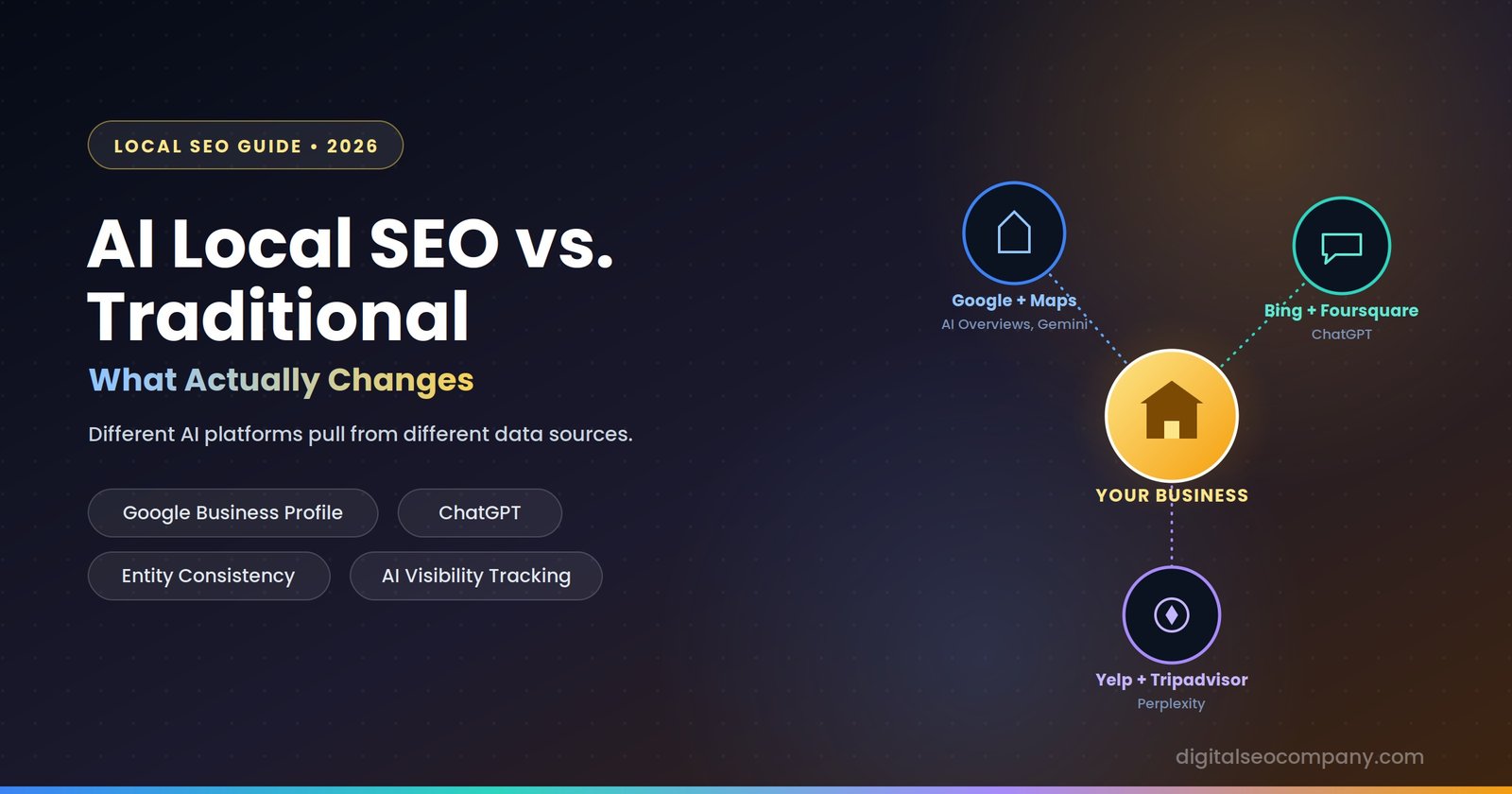
Traditional local SEO optimizes for Google’s Map Pack using proximity, Google Business Profile completeness, and reviews. AI local SEO optimizes for being named inside a synthesized answer — from ChatGPT, Perplexity, Gemini, or Google’s own AI Overviews — and the biggest difference most businesses miss is that these AI systems don’t all read from the same data. Google’s AI tools draw on the same local index and Business Profile data traditional local SEO has always targeted. ChatGPT, by contrast, leans heavily on Bing’s index and Foursquare’s business data. Perplexity pulls from Yelp, Google Maps data, and Tripadvisor. Optimizing for “AI local search” isn’t one target — it’s several distinct ecosystems that happen to overlap on some of the same fundamentals.
This article breaks down exactly what’s changed, what genuinely hasn’t, and what new work actually belongs on a local SEO checklist in 2026.
The Short Answer: Same Foundation, Different Discovery Layer
If you’ve already read our local SEO guide, you know the fundamentals: Google Business Profile, reviews, citations, and proximity. None of that has gone away — if anything, it matters more now, because AI systems rely on exactly that same data as their primary source of truth. What’s changed is the layer sitting on top of it: instead of (or in addition to) a ranked list of links, a growing share of local queries now get answered directly by a synthesized summary, and that summary either names your business or it doesn’t.
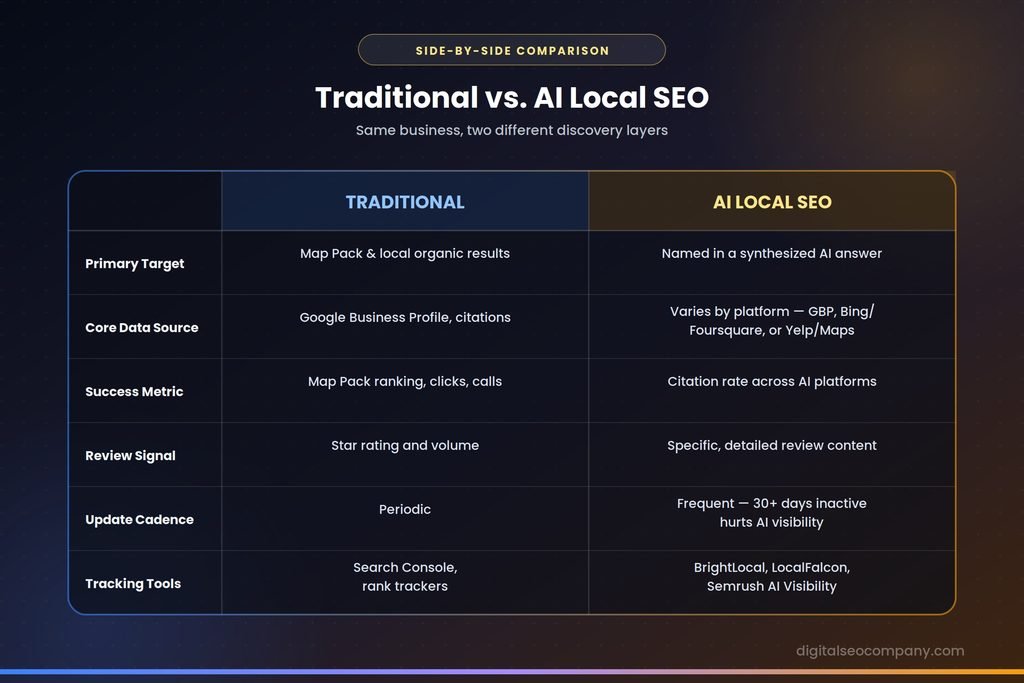
Traditional Local SEO vs. AI Local SEO: Side by Side
| Traditional Local SEO | AI Local SEO | |
| Primary target | Google’s Map Pack, local organic results | Being named in a synthesized AI answer |
| Core data source | Google Business Profile, citations | GBP (for Google’s AI) — but Bing/Foursquare for ChatGPT, Yelp/Maps/Tripadvisor for Perplexity |
| Success metric | Map Pack ranking, clicks, calls | Citation/mention rate across AI platforms |
| Review signal | Star rating and volume | Specific, detailed review content AI can summarize accurately |
| Content need | Location pages, on-page optimization | Same content, plus FAQ-formatted, directly-answerable sections |
| Update cadence | Periodic | Frequent — profiles inactive 30+ days show measurable visibility drops in AI search specifically |
| Tracking tools | Google Search Console, Map Pack rank trackers | BrightLocal, Whitespark, LocalFalcon, Semrush AI Visibility |
What Hasn’t Changed — And Shouldn’t Be Ignored
It’s worth being direct about this before going further: AI hasn’t rewritten the fundamentals, it’s added a layer on top of them.
- Proximity still matters enormously for local intent queries — no AI system has removed distance from the equation
- Category accuracy still matters — a mismatched or overly broad GBP category confuses both Google’s traditional algorithm and its AI systems equally
- Genuine service quality, reflected in real reviews, still outweighs technical optimization — no amount of schema markup compensates for a business people don’t actually recommend
Some businesses assume AI Overviews reduce the importance of Google Business Profile, since the AI increasingly gives the answer directly instead of prompting more clicks. The opposite is true: GBP is the richest, most structured local data source Google has, and its AI systems lean on it more, not less.
What’s Genuinely New: AI Platforms Don’t Share One Data Source
This is the part most “AI local SEO” advice skips, and it’s the single most actionable insight in this comparison. Different AI assistants are grounded in different underlying local data:
- Google AI Mode, AI Overviews, Gemini, and Ask Maps all run on Google’s own local index, Business Profile, and Maps data — the same ecosystem traditional local SEO has always optimized for
- ChatGPT doesn’t use Google’s index at all. It leans heavily on Bing’s index and Bing Places, and independent testing points to Foursquare’s business data as a primary local source
- Perplexity pulls from Yelp, Google Maps data, Tripadvisor, and vertical directories relevant to the query
The practical implication: a business with a flawless Google Business Profile but no presence on Bing Places, Foursquare, or Yelp may be fully optimized for Google’s AI systems while remaining nearly invisible to ChatGPT, and here comes about GEO services. “Optimizing for AI local search” has to mean maintaining accurate, consistent presence across multiple directory ecosystems, not just the one Google-centric stack traditional local SEO trained everyone to focus on.
The Query Itself Has Gotten More Specific
Traditional local SEO was built around relatively short, predictable queries — “plumber,” “plumber near me,” “emergency plumber [city].” AI-mediated search behaves differently, because a conversational interface invites a longer, more specific question: not “plumbers,” but “plumbers who handle 24/7 emergency pipe bursts in the West End.” That shift matters for content strategy — a location page built to rank for short head terms often has nothing on it that directly answers the longer, more specific version of the same intent, which is increasingly what the AI layer is actually trying to match against.
This is also where detailed service descriptions earn their keep twice over: they help traditional on-page relevance the way they always have, and they give AI systems the specific phrase-level material needed to match a long, conversational query to your business rather than a generic competitor with thinner content.
The Entity Consistency Shift
Traditional local SEO treats NAP consistency (name, address, phone) as a ranking hygiene factor. AI local search raises the stakes: these systems read your Google Business Profile, website, reviews, and third-party mentions together, as a single representation of your business, when deciding whether to cite you with confidence. A conflict — your GBP says open, your website says closed for the holiday — doesn’t just look sloppy anymore. It actively reduces the AI’s confidence in recommending you at all, because the system has no reliable way to resolve which source is correct.
New Metrics Worth Tracking
Map Pack position and organic clicks are no longer the full picture. A few data points worth it to understand real-world performance:
- Industry research tracking AI local recommendations found Google’s three-pack still surfaces a given business roughly 36% of the time in its own results, compared to roughly 11% for Gemini, 7% for Perplexity, and just over 1% for ChatGPT — a reminder that ChatGPT, while a fast-growing discovery channel, remains extremely selective about which specific businesses it names by default
- Consumer surveys show a sharp swing toward AI-assisted local discovery — researchers at BrightLocal found AI tool usage for finding a local business jumped from roughly 6% of consumers to 45% in a single year
- AI Overviews now appear on a majority of local search queries in some analyses, and their presence is associated with meaningfully lower click-through to traditional organic results — visibility inside the AI answer is increasingly the win, not just the click past it
Dedicated tools now exist specifically for this: BrightLocal and Whitespark both track appearances in local AI Overviews, LocalFalcon covers Google AI Overviews, AI Mode, and ChatGPT together, and Semrush’s AI Visibility feature tracks share of voice across AI platforms generally.
A Reality Check: Not Every “AI SEO” Tactic Moves the Needle
Worth including honestly: not every tactic marketed as “AI local SEO” has measurable impact. At least one rigorous difference-in-differences study found roughly zero measurable effect on ChatGPT and Google AI Mode citation rates from a commonly recommended optimization, and a slightly negative effect on AI Overviews specifically. The takeaway isn’t that AI local optimization doesn’t work — the data throughout this article says otherwise — it’s that this field is young enough that not every popular recommendation has been rigorously tested, and skepticism toward any single tactic promising guaranteed AI visibility is warranted.
Practical Changes to Make Now
- Keep Google Business Profile active, not just complete — profiles untouched for 30+ days show measurable AI visibility drops.
- Claim and maintain Bing Places and Foursquare, not just Google Business Profile, since ChatGPT draws primarily from these rather than Google’s data.
- Request detailed reviews, not just star ratings — a review mentioning a specific service gives AI systems concrete material to summarize accurately, versus a generic five-star rating with no content.
- Add FAQ-formatted sections with schema markup — pages with FAQ schema are measurably more likely to be pulled into AI Overview responses.
- Build genuinely distinct location pages, not templated ones — generic, duplicated location content gives AI systems little unique signal and can dilute location-specific recommendations across your own pages.
- Audit for entity conflicts — hours, services, and claims that don’t match across your GBP, website, and major directories.
- Write service descriptions that answer longer, specific questions, not just short head terms — the conversational phrasing AI interfaces invite needs content that actually addresses it directly, not a generic page hoping a short keyword match is enough.
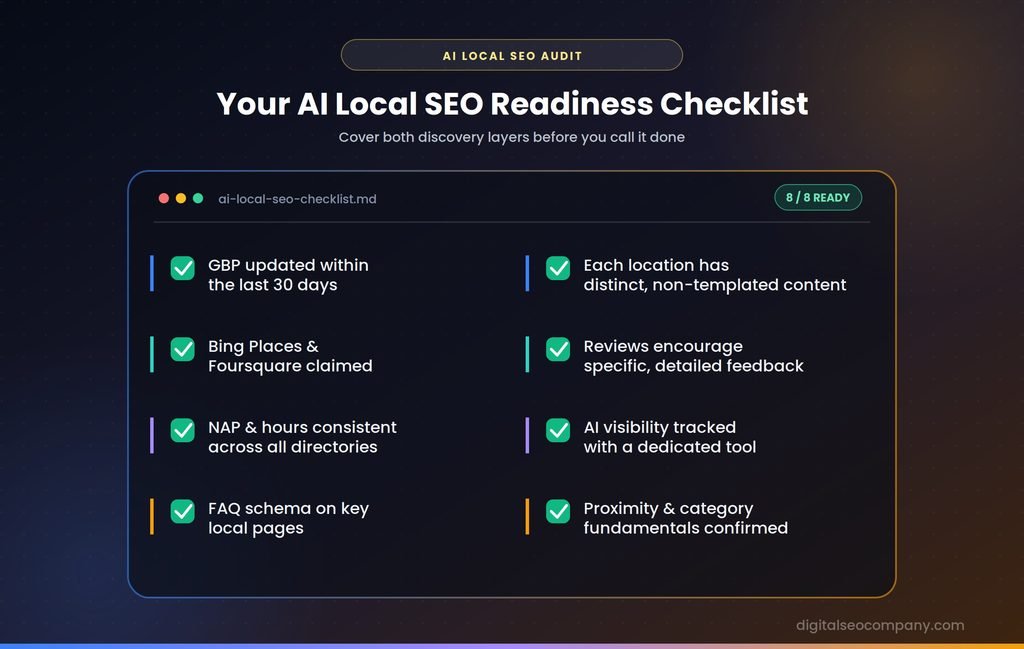
Checklist: AI Local SEO Readiness
- Google Business Profile updated within the last 30 days
- Bing Places and Foursquare listings claimed and accurate
- NAP and hours consistent across GBP, website, and major directories
- FAQ schema implemented on key local pages
- Each location has genuinely distinct, non-templated content
- Review solicitation encourages specific, detailed feedback
- AI visibility tracked with a dedicated tool (BrightLocal, Whitespark, LocalFalcon, or similar)
- Core local SEO fundamentals (proximity signals, category accuracy) confirmed solid
Frequently Asked Questions
Is AI local SEO replacing traditional local SEO?
- No. AI local search adds a new discovery layer on top of the same fundamentals — Google Business Profile, reviews, and proximity remain core. What’s changed is how that data gets surfaced, and which additional platforms (Bing Places, Foursquare, Yelp) now matter beyond Google’s own ecosystem.
Does ChatGPT use Google Business Profile?
- Not directly as its primary source. ChatGPT leans heavily on Bing’s index and Foursquare’s business data rather than Google’s local index, which is why a business fully optimized for Google can still be invisible to ChatGPT specifically.
How often should I update my Google Business Profile for AI search?
- Local SEO practitioners tracking this in 2026 have observed measurable visibility drops in AI search for profiles left untouched for 30 or more days — more frequent than many businesses historically treated GBP maintenance.
Do I need separate strategies for Google’s AI and ChatGPT?
- Not entirely separate, but they do require different directory presence. Google’s AI tools draw from the same Business Profile and Maps data traditional local SEO already targets; ChatGPT and Perplexity require active presence on Bing Places, Foursquare, Yelp, and similar platforms to be reliably cited.
What’s the best way to track AI local visibility?
- Dedicated tools have emerged specifically for this: BrightLocal and Whitespark track local AI Overview appearances, LocalFalcon covers Google AI Overviews, AI Mode, and ChatGPT together, and Semrush’s AI Visibility feature tracks broader share of voice across AI platforms.
Final Thought
AI hasn’t replaced local SEO — it’s revealed that “local SEO” was always narrower than it should have been, quietly scoped to Google’s ecosystem alone. The businesses adapting fastest aren’t doing something fundamentally different; they’re doing the same fundamentals (accurate data, real reviews, genuine relevance) across more platforms than Google Business Profile alone, because that’s where the next generation of local discovery is actually happening. Contact now if you’re interested about free local AI visibility audit.