
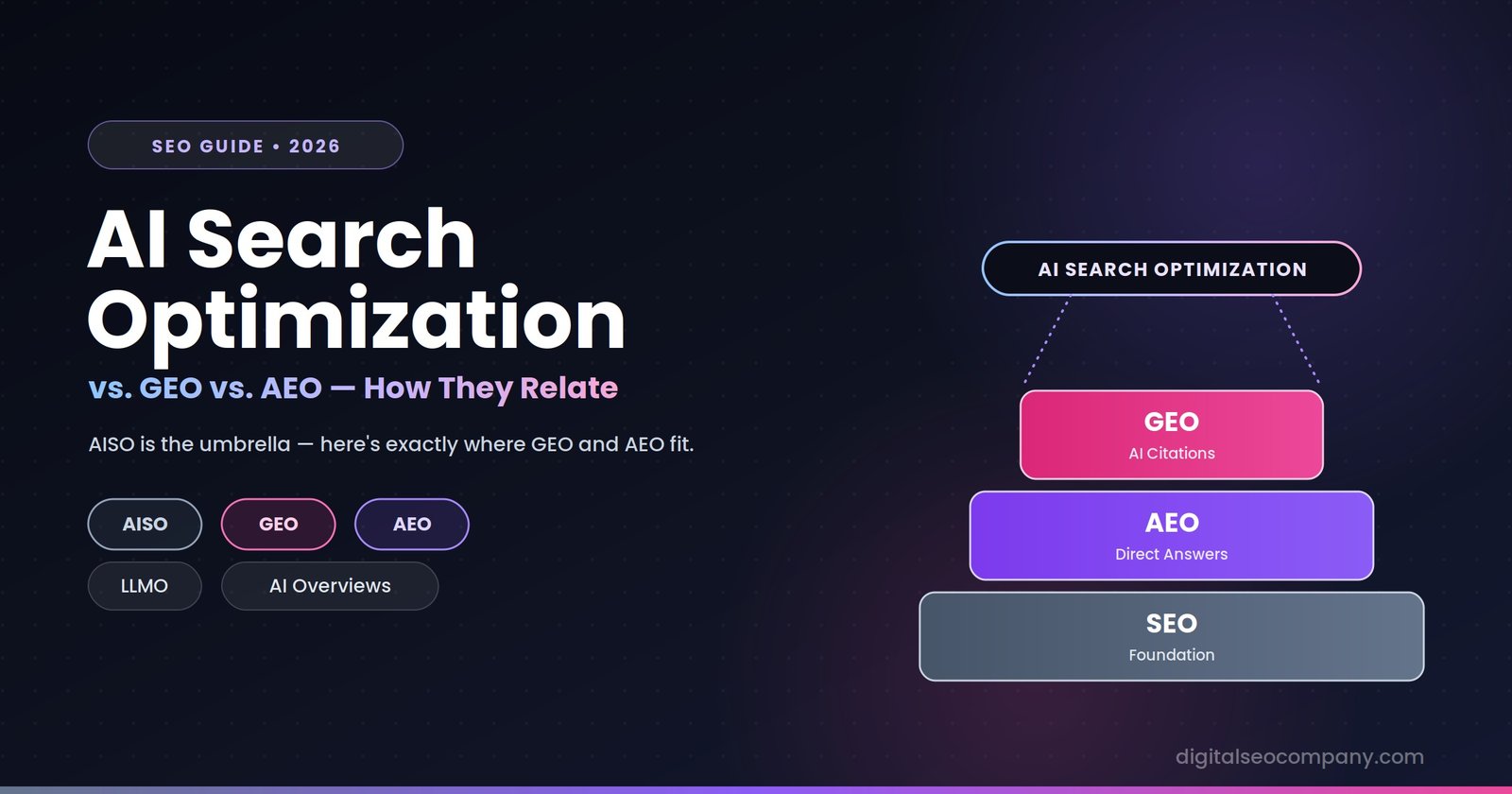
AI Search Optimization is the umbrella term for making a brand visible inside AI-generated answers — across ChatGPT, Gemini, Claude, Perplexity, Copilot, and Google’s AI Overviews — while GEO and AEO are more specific disciplines that sit underneath it, not separate categories competing with it. That’s the framing most of the industry has converged on. What hasn’t converged is the second-order question: whether GEO is the narrower term inside that umbrella, whether AEO is, or whether they’re simply two competing names for the same underlying work. This article covers both — the settled part and the genuinely unsettled part — so you’re not left with a false sense of consensus where none exists.
If you’ve already read our breakdown of SEO vs. AEO vs. GEO, this is the companion piece: that article compared three disciplines by the search surface each one targets. This one goes one level deeper, into the relationship between AI Search Optimization, GEO, and AEO specifically — because “AI Search Optimization” isn’t a fourth sibling discipline the way SEO, AEO, and GEO are to each other. It’s the category they both belong to.
Why This Question Keeps Coming Up
New terminology in a fast-moving field tends to arrive faster than agreement on what it means. In the space of about two years, the industry has produced AEO, GEO, AIO, AISO, and LLMO — five acronyms circling a genuinely new problem: how do you get a brand mentioned inside an answer a machine generates, rather than ranked in a list a human scrolls through? Different agencies, tools, and thought leaders adopted different terms first, and none of them have since backed down. The result is exactly the confusion you’d expect: two vendors can use “AEO” to mean different things, and a client reading both sites walks away more confused than when they started.
What “AI Search Optimization” Actually Means
AI Search Optimization (sometimes shortened to AISO, or referred to as AIO) describes the overall discipline of making content, brand entities, and data structured and credible enough that AI systems choose to surface them — whether that’s a direct answer, a citation, or a recommendation. It spans every AI-mediated surface at once: Google’s AI Overviews and AI Mode, ChatGPT, Gemini, Claude, Perplexity, and Microsoft Copilot. Under this framing, the goal isn’t optimizing for one specific platform’s behavior — it’s building the kind of crawlable, well-structured, entity-consistent presence that works across all of them, because the underlying requirement (clear, citable, trustworthy content) doesn’t change much from one AI system to the next.
How GEO Fits Under the Umbrella
Generative Engine Optimization is the discipline focused specifically on one part of that picture: earning a citation or mention inside a generative model’s synthesized response — the kind of answer ChatGPT or Perplexity assembles by pulling from multiple sources and writing something new, rather than quoting one source directly. GEO’s core levers are things like original data, clear source authority, and content structured in a way that’s easy for a model to extract and attribute. The term traces back to a 2023 research paper and was popularized more recently by a well-known venture capital firm’s 2025 industry thesis, which is part of why it caught on quickly in marketing circles even though it’s the newest of these terms.
How AEO Fits Under the Umbrella
Answer Engine Optimization is the discipline focused on structuring content so it gets selected as a direct answer — traditionally this meant featured snippets and voice assistant responses, and it’s expanded to include AI answer boxes as those became common. AEO is the older term here, tracing back to around 2018, well before generative AI search existed in its current form. Its core levers are things like tight, self-contained answers near the top of a section, clear heading structure, and FAQ-formatted content that’s easy to lift out of context.
A Brief History of How We Got Five Acronyms
Understanding the timeline helps explain why the definitions don’t line up cleanly. AEO is the oldest term here, emerging around 2018 as Google’s search results started filling with featured snippets and knowledge panels — well before generative AI search existed in anything like its current form. GEO arrived much later, tracing to a 2023 academic paper studying how to optimize content for generative retrieval systems, and it didn’t reach mainstream marketing vocabulary until a prominent venture capital firm’s 2025 industry thesis put real weight behind the term. AIO and AISO are newer still, coined largely by agencies and platforms trying to name the umbrella that GEO and AEO both seemed to be sitting under, once it became clear neither term alone captured the full picture. You may also encounter LLMO (LLM Optimization), a fifth term some practitioners use interchangeably with GEO, specifically emphasizing optimization for large language models rather than generative AI more broadly.
That staggered timeline — one term from 2018, one from a 2023 paper, several more coined in the last two years — is a large part of why they don’t fit together neatly. AEO wasn’t originally designed to coexist with GEO; GEO was created to describe something AEO’s original 2018 definition didn’t yet need to cover.
The Real Disagreement: Is AEO Broader or Narrower Than GEO?
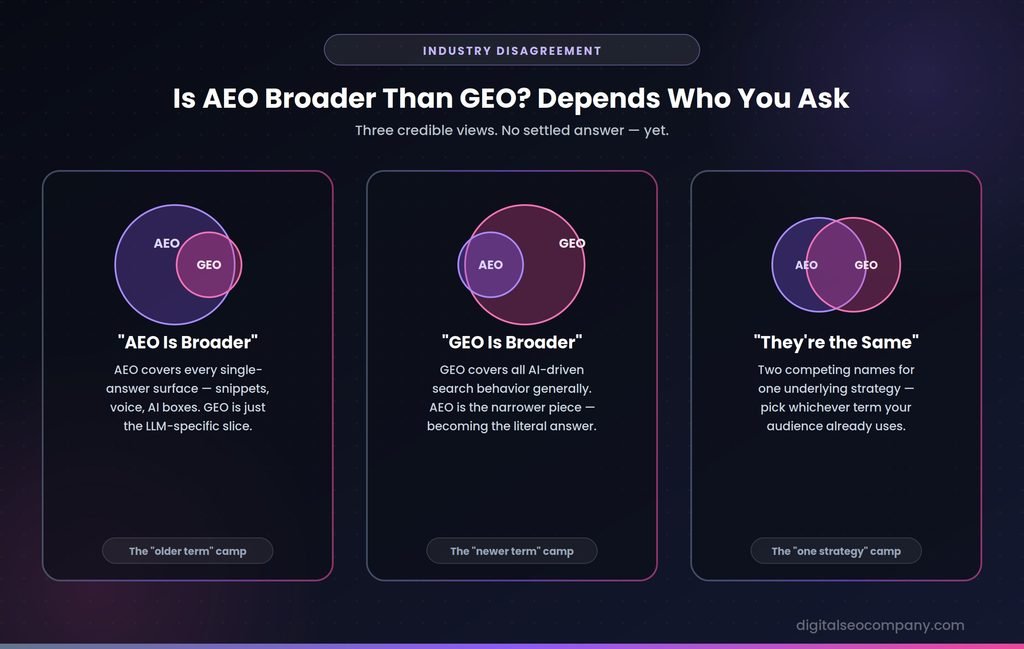
Here’s where honesty matters more than a clean answer. Researching this piece surfaced genuinely conflicting positions from credible sources, and presenting only one would be misleading:
- One view: AEO is the broader, older umbrella, covering any single-answer surface (snippets, voice, AI Overviews), with GEO as a narrower subset specifically about LLM-generated synthesis.
- The opposite view: GEO is broader, covering all AI-driven search behavior generally, with AEO as the narrower piece focused specifically on becoming the literal extracted answer.
- A third view, from at least one AI-visibility platform, argues they’re simply the same strategy with two competing names — and takes a specific position that GEO was the wrong name to have won out, since “generative engines” is a vaguer, less durable description than “answer engines.”
There is no governing body standardizing this vocabulary, and as of 2026, no single definition has become dominant enough to call the debate settled. If you see AEO and GEO defined with reversed scope on two different websites, neither one is necessarily wrong — they’re reflecting real, unresolved disagreement in a genuinely new field, not making an error.
A Useful Mental Model: The Three-Layer Stack
Rather than trying to draw a hard boundary between the terms, one framing several practitioners have converged on treats this as a layered stack, where each layer depends on the one beneath it:
- SEO (foundation) — crawlability, indexing, technical health, and content depth. Without this layer, nothing above it has anything solid to build on.
- AEO (middle layer) — structuring that solid content into clear, extractable, direct answers.
- GEO (top layer) — earning citation and synthesis across AI systems, which depends on the content already being well-structured (AEO) and technically sound (SEO) in the first place.
Under this model, “AI Search Optimization” isn’t a fourth layer — it’s the name for doing all three well, together, as a coordinated strategy rather than three disconnected tactics.
Why the Naming Debate Matters Less Than It Seems
Here’s the practical takeaway, regardless of which definition you find most convincing: the underlying work is nearly identical no matter which acronym you organize it under. Clean technical SEO, extractable answer-formatted content, accurate structured data, and consistent brand presence across the web are the same four things every version of this taxonomy ultimately points back to. Spending significant time picking the “correct” term is time not spent doing the actual work that earns visibility under any of them.
Where the terminology does matter is communication — with clients, with a team, or across an organization. Pick one framework, define your terms explicitly the first time you use them, and stay consistent, rather than switching vocabulary project to project.
What AI Search Optimization Actually Involves in Practice
Regardless of naming, the practical work spans:
- Technical foundation — crawlability, indexing, and site speed, since AI crawlers need the same clean access traditional search crawlers do (see our [technical SEO guide])
- Structured data — schema markup that gives AI systems unambiguous facts to cite rather than text to interpret
- Extractable content structure — direct answers early in each section, clear headings, FAQ formatting
- Entity consistency — your brand name, facts, and claims matching across your site, directories, and third-party mentions
- Original, citable material — data, frameworks, or insights that give an AI system something specific to attribute to you, rather than generic content available from a dozen other sources
If you manage this work for clients or report on it internally, the terminology confusion is worth addressing directly rather than avoiding. A short line in a proposal or report — “we use ‘AI Search Optimization’ as the umbrella term for this work; you may also see it called AEO, GEO, or AIO elsewhere, and they largely describe the same underlying effort” — heads off the confusion before a client encounters conflicting definitions somewhere else and wonders whether they’re getting the wrong service. Read our full technical SEO guide to clear confusions.
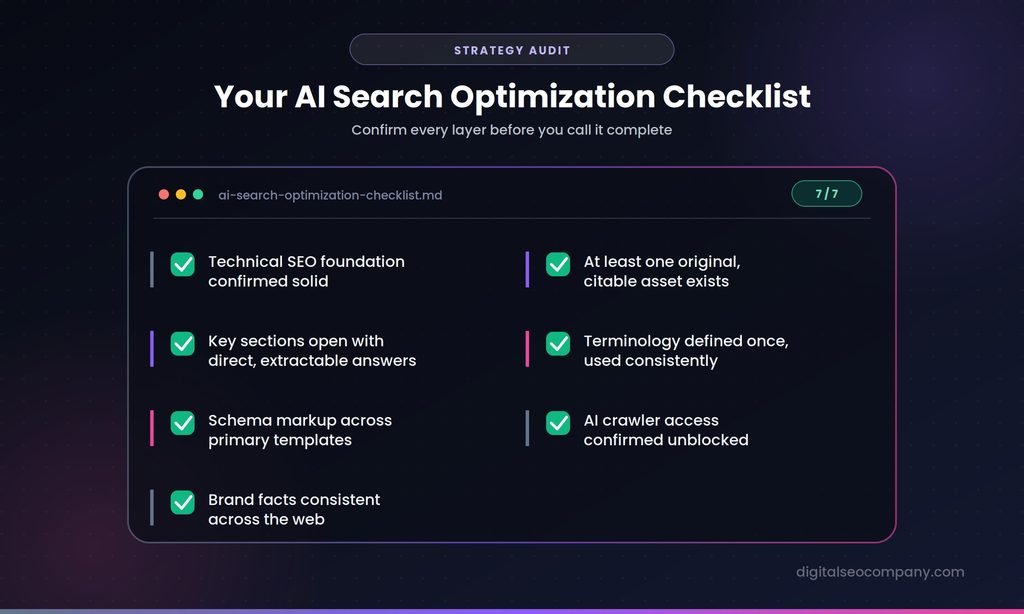
Checklist: Is Your AI Search Optimization Strategy Actually Layered?
- Technical SEO foundation confirmed solid (crawlable, indexed, fast)
- Key content sections open with direct, extractable answers
- Schema markup implemented across primary templates
- Brand facts and NAP-style details consistent across the web
- At least one original, citable asset exists (data, framework, or research)
- Terminology defined once and used consistently across your own materials
- AI crawler access confirmed unblocked (robots.txt, firewall rules)
Frequently Asked Questions
Is AI Search Optimization the same as GEO?
- No — AI Search Optimization is the broader umbrella term, and GEO services is one specific discipline underneath it, focused on citation inside generative AI responses specifically.
Is AEO part of AI Search Optimization too?
- Yes. GEO and AEO Services are both generally considered sub-disciplines within AI Search Optimization, even though sources disagree on exactly how their individual scopes relate to each other.
Which term should I use — AEO, GEO, or AI Search Optimization?
- There’s no industry-standard answer. Pick the term that matches how your audience or team already talks about this work, define it clearly the first time you use it, and stay consistent — the underlying tactics are nearly identical across all three framings.
Do I need to master all three disciplines separately?
- Not as separate initiatives. Most practitioners treat this as one layered strategy — solid SEO first, then answer-formatted content (AEO), then citation-focused authority building (GEO) — rather than three unrelated projects.
Why do different websites define AEO and GEO differently?
- Because the terminology genuinely hasn’t been standardized yet. Both terms emerged within the last few years to describe a fast-moving, still-developing area of search, and no governing body has settled the definitions the way, for example, W3C standards settle web specifications.
What is LLMO, and is it different from GEO?
- LLMO (LLM Optimization) is a fifth term some practitioners use, largely interchangeably with GEO, to describe optimizing content specifically for how large language models retrieve and synthesize information. It’s less commonly used than GEO or AEO, but you may encounter it, particularly from more technically focused sources.
Final Thought
The acronyms in this space will likely keep shifting for a while longer, and chasing a “correct” definition is largely a distraction from the work itself. What’s stable is the shape of the problem: search now has traditional rankings, direct answers, and generative citations as three distinct outcomes, and a coordinated strategy — whatever you call it — has to address all three rather than picking a favorite acronym and stopping there. Contact us now to do a free AI search visibility audit.