
Every few years, someone declares SEO dead. It happened when social media exploded. It happened when voice search arrived. And now it’s happening again with the rise of ChatGPT, Perplexity, and Google AI Overviews.
The claim sounds convincing on the surface — why optimize for search rankings when users are getting answers directly from AI, without ever clicking a link?
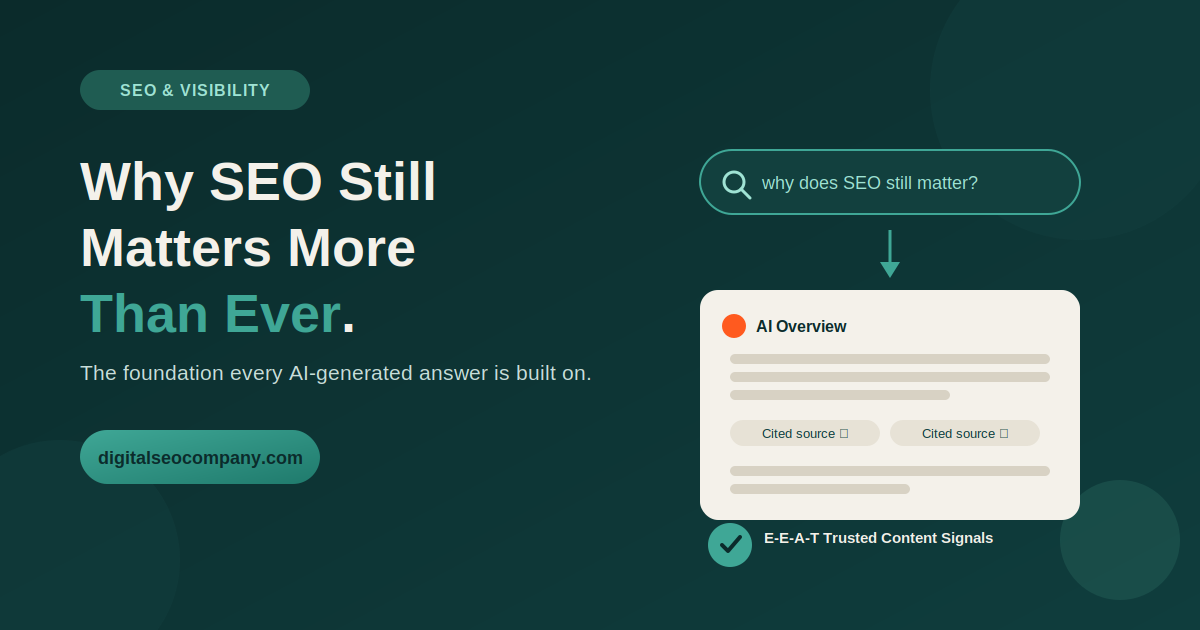
But look closer, and the opposite is true. SEO isn’t losing relevance. It’s becoming the foundation that every AI-generated answer is built on. If your content isn’t structured, authoritative, and trustworthy enough to rank in traditional search, it isn’t structured, authoritative, or trustworthy enough to be cited by an AI system either.
Here’s why SEO still matters more than ever — and why the businesses treating it as optional are about to fall behind.
1. Traditional Search Still Drives Billions of Daily Queries
Despite the hype around AI chatbots, Google alone still processes an estimated 13 billion searches every single day. That number hasn’t shrunk — if anything, search behavior has diversified across more platforms, not disappeared from the original one.
This means organic rankings still directly influence whether your business gets found. A significant share of buying journeys, local searches, and research queries still start with a traditional search bar, and ranking in the top three results remains one of the most reliable ways to earn a click.
If you deprioritize SEO because “AI is taking over search,” you risk losing visibility in the channel that’s still doing the heavy lifting today.
2. AI Answer Engines Are Evaluating Content Using SEO’s Core Principles
Here’s the part most businesses miss: Answer Engine Optimization (AEO), the practice of getting cited inside AI-generated answers, isn’t a replacement for SEO. It’s built directly on top of it.
When an AI system like ChatGPT, Perplexity, or Google’s AI Overview generates a response, it’s evaluating potential sources against criteria that will feel very familiar:
- Content clarity — is the information easy to understand and extract?
- Domain reputation — is this a site other credible sources trust?
- Consistency with other trusted sources — does this align with what the rest of the web says?
- Extractability — is the content structured in a way that’s easy to pull from?
These are the exact same signals that have driven strong SEO for over a decade: high-quality content, clear site structure, backlink authority, and technical health. A site that has already invested in these fundamentals has a real head start when it comes to earning AI citations. A site that hasn’t is starting from behind on both fronts at once.
3. E-E-A-T Still Decides Who Gets Trusted — By Google and By AI
Google’s E-E-A-T framework — Experience, Expertise, Authoritativeness, and Trustworthiness — has guided quality content evaluation for years. It’s not going anywhere. If anything, it’s becoming more important.
When an AI system is synthesizing an answer from multiple sources, it has to decide which of those sources are credible enough to draw from. Content that demonstrates genuine expertise, is backed by credible authors, and comes from an authoritative domain is far more likely to be pulled into a generated response. Thin, generic, or unverified content — the kind that never ranked well in traditional search either — gets passed over.
In other words, the sites that were already doing SEO right are the sites AI systems trust most.
4. Ranking Is About a Position. Being Cited Is About Trust.
It’s worth being precise about the distinction here, because it changes how you should think about content strategy.
- Ranking is about earning a position on a results page, based on hundreds of signals like keyword relevance, backlink authority, page speed, and engagement.
- Being cited is about earning a place inside a generated answer, based on whether an AI system judges your content useful, trustworthy, and clearly structured enough to extract from.
These aren’t competing goals. They’re two outcomes of the same underlying work. A page that ranks well because it’s well-structured, authoritative, and genuinely useful is also a page an AI system is more likely to cite. Neglect the fundamentals, and you lose ground in both places at once.
5. Backlinks and Brand Mentions Still Build Authority — Just in an Expanded Way
Backlinks have long been one of the strongest authority signals in SEO, and they still matter. A page with high-quality backlinks continues to rank better because those links function as third-party endorsements.
But authority signals have expanded, not disappeared. AI systems also pay close attention to brand mentions across independent sources — publications, forums, review sites, and social platforms — even when those mentions don’t include a link. An AI system scanning Reddit threads, review sites, and industry articles is essentially looking for consensus: do multiple independent voices agree that your brand is credible in your space?
The more consistently your brand shows up — in links and in mentions — the stronger your authority signal becomes across both traditional search and AI-generated answers.
6. Structured Data Is More Valuable Than Ever
In traditional SEO, structured data (schema markup) helped pages qualify for rich results — star ratings, FAQs, step-by-step instructions. That value hasn’t gone away.
But structured data now serves a second purpose: it makes your content dramatically easier for AI systems to read, interpret, and extract. It won’t guarantee a citation on its own, but it removes ambiguity, and ambiguous content is the first thing an AI system skips over in favor of a source that’s easier to work with.
If your site hasn’t implemented clean, accurate schema, you’re leaving both traditional rich-result opportunities and AI-extraction advantages on the table.
7. Poor SEO Doesn’t Just Hurt Rankings Anymore — It Costs You AI Visibility Too
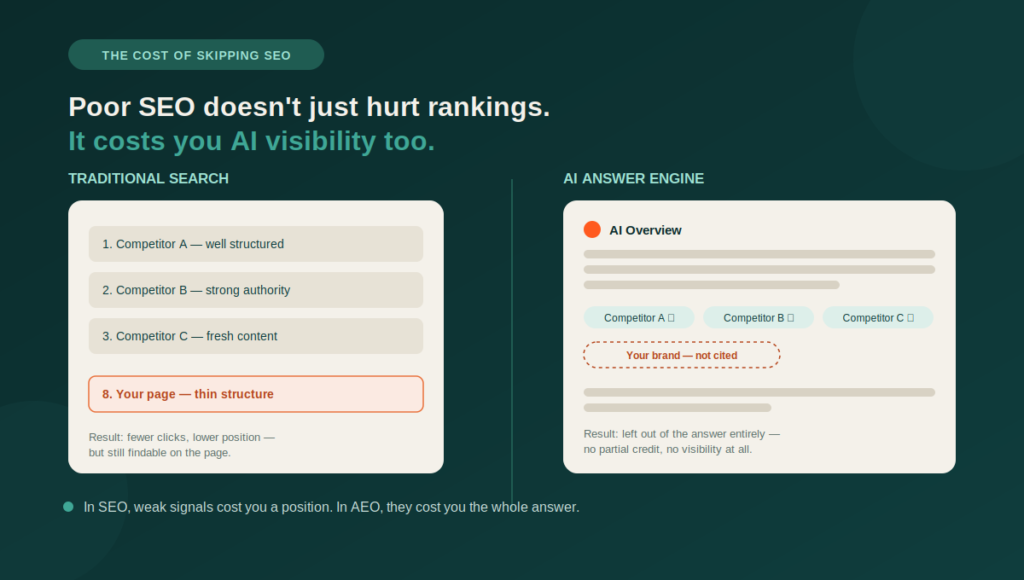
In traditional SEO, weak content structure or thin authority might cost you a few positions on the results page. That’s a real cost, but a contained one.
In the AI search era, the stakes are higher. If your content is hard to extract, poorly organized, or lacking clear signals of credibility, it may not be considered by an AI system at all — regardless of how well it happens to rank in traditional search. There’s no partial credit. Either your content is trustworthy and well-structured enough to be woven into an AI-generated answer, or it’s invisible in that channel entirely.
This is exactly why treating SEO as a “nice to have” is now riskier than ever. The cost of skipping the fundamentals has grown, not shrunk.
8. SEO and AEO Aren’t Competing Strategies — They’re the Same Strategy
The biggest misconception driving the “SEO is dead” narrative is the assumption that businesses now have to choose between optimizing for traditional search and optimizing for AI answer engines.
They don’t. The strongest content strategies treat SEO and AEO as two expressions of the same underlying discipline:
- High-quality, expert content — for both rankings and citations
- Clear, logical page structure — for both crawlability and extractability
- Genuine authority through backlinks and consistent brand mentions — for both domain trust and AI credibility
- A technically sound, fast, and crawlable site — for both search engines and AI retrieval systems
Businesses that keep investing in these fundamentals are positioning themselves to win in both traditional results pages and AI-generated answers. Businesses that abandon SEO in favor of chasing AI visibility alone are cutting off the foundation that AI visibility is actually built on.
The Bottom Line
SEO isn’t being replaced by AI search — it’s being tested by it, and it’s holding up. The core principles that have driven search success for years — quality content, strong authority, clear structure, and technical health — are now also the building blocks of AI citation.
The question isn’t whether SEO still matters. It’s whether your content is strong enough to earn visibility in a search landscape where the bar has actually gotten higher, not lower.
If you’re ready to build a content strategy that earns visibility across both traditional search results and AI-generated answers, Digital SEO Company can help you get there — with a foundation strong enough to compete in either arena.