
On-page SEO is the practice of optimizing individual elements on a webpage — its content, HTML tags, structure, and internal links — so search engines and AI answer engines can understand it, trust it, and rank it. It covers everything you directly control on your own site: title tags, headers, keyword placement, content quality, internal linking, images, schema markup, and page experience. Unlike backlinks or brand mentions, on-page SEO doesn’t depend on anyone else — which makes it the fastest, most controllable lever for improving rankings.
In 2026, on-page SEO has expanded beyond ranking on Google’s traditional results page. With AI Overviews now appearing on a large share of search queries, on-page SEO is also what determines whether your content gets pulled into an AI-generated answer, cited by ChatGPT or Perplexity, or skipped entirely. Get the fundamentals wrong, and no amount of backlinks or content volume will fix it.
Why On-Page SEO Still Comes First
Search engines can’t rank what they can’t understand. Before Google — or an AI model — decides whether your page deserves to rank, it has to answer a few basic questions:
- What is this page actually about?
- Does it fully answer the searcher’s question?
- Is it well-structured enough to extract a clear answer from?
- Can the source (you) be trusted?
On-page SEO is how you answer those questions directly, in a format machines can parse. Off-page signals like backlinks tell search engines how popular a page is. On-page SEO tells them what the page is and whether it deserves that popularity in the first place. A page with strong backlinks but poor on-page structure will still underperform pages that are properly optimized — and it will almost never get pulled into an AI-generated summary, because those systems extract answers at the passage level, not the domain level.
On-Page vs. Off-Page vs. Technical SEO
These three terms get mixed up constantly, so it’s worth being precise:
| Type | What it covers | Example |
| On-page SEO | Elements on the page itself: content, tags, headers, internal links | Writing a clear title tag, structuring H2s around subtopics |
| Off-page SEO | Signals earned outside your site | Backlinks, brand mentions, social shares |
| Technical SEO | How well search engines can crawl, render, and index your site | Site speed, crawlability, XML sitemaps, canonical tags |
On-page and technical SEO overlap at the edges (Core Web Vitals, for instance, sits in both camps), but the simplest way to separate them: on-page SEO is about relevance and clarity, technical SEO is about accessibility, and off-page SEO is about trust and authority.
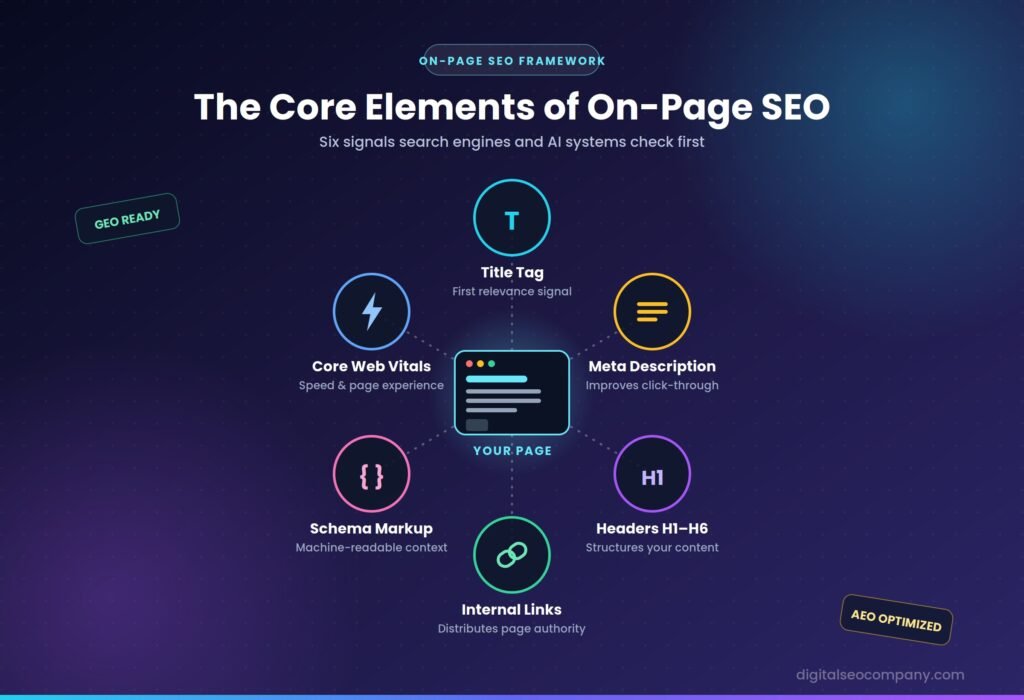
The Core Elements of On-Page SEO
1. Title Tags
The title tag is the single strongest on-page relevance signal you control. It’s also your ad copy in the SERP — it decides whether someone clicks.
- Keep it under ~60 characters so it doesn’t get truncated
- Lead with the primary keyword where it reads naturally
- Make every title unique across the site — duplicate titles confuse search engines about which page to rank
- Write for humans first; a title that gets clicks and satisfies intent outperforms one that’s just keyword-matched
2. Meta Descriptions
Meta descriptions don’t directly influence rankings, but they influence click-through rate — which indirectly affects how search engines judge a page’s relevance over time.
- Stay within ~150–160 characters
- Include the focus keyword naturally
- Write it like ad copy: state the benefit, not just the topic
- Add a soft call-to-action where it fits (“Learn how,” “See the checklist”)
3. Header Tag Structure (H1–H6)
Headers aren’t just styling — they’re a map that tells both readers and machines how your content is organized.
- Use exactly one H1 per page, matching the primary topic
- Structure H2s around the major subtopics a searcher expects covered
- Use H3s for supporting details under each H2
- Write headers as if each one could stand alone as a mini-answer — this is what lets AI systems and featured snippets extract a section cleanly without needing the rest of the page
- Avoid skipping levels (e.g., H2 straight to H4) — it breaks the logical hierarchy
4. URL Structure
Clean URLs help both crawlability and user trust.
- Keep URLs short and descriptive
- Include the focus keyword
- Use hyphens, not underscores, to separate words
- Avoid dates, session IDs, or unnecessary parameters that add no meaning
- If you ever change a URL, 301-redirect the old one — don’t let it die
5. Keyword Placement & Semantic Coverage
Modern on-page SEO isn’t about repeating a keyword a set number of times — it’s about proving topical completeness.
- Mention your primary keyword early, ideally in the first 100 words
- Use it naturally in at least one H2
- Weave in semantically related terms and entities instead of repeating the exact phrase (search engines and LLMs now match meaning, not just strings)
- Think in terms of query fan-out: when someone searches a broad topic, AI systems break it into related sub-questions and look for content that answers each one. A page that only targets one exact phrase misses all of that surrounding demand — a page that covers the full topic cluster captures it.
6. Content Quality & Depth (E-E-A-T)
Content is still the factor that carries the most weight — but “quality” now has a specific, checkable meaning:
- Experience — does the content show real, first-hand familiarity with the topic?
- Expertise — is it accurate and specific, not generic filler?
- Authoritativeness — is the author or brand a credible source on this subject?
- Trustworthiness — are claims backed up, sources cited, and information kept current?
Practically: answer the query completely in one visit, avoid padding word count with fluff, and update pages periodically rather than letting them go stale. Comprehensive, first-page-competitive articles on informational topics tend to run well over 1,000 words — but length is a byproduct of depth, not a target to hit.
7. Internal Linking
Internal links are the only link-building lever entirely within your control, and they do double duty:
- They distribute authority from strong pages to newer or weaker ones
- They tell search engines how your content is topically related (crucial for building topical authority around a hub-and-spoke structure)
- They keep readers on-site longer, which strengthens engagement signals
Link every new post to two or three relevant existing pages, and keep important pages reachable within a few clicks of the homepage.
8. Image Optimization
Images affect both rankings and page speed:
- Use descriptive, keyword-relevant file names (on-page-seo-checklist.jpg, not IMG_2931.jpg)
- Write specific alt text that describes the image — this also matters for accessibility
- Compress and serve modern formats (WebP/AVIF) to protect load speed
- Lazy-load images below the fold
9. Schema Markup (Structured Data)
Schema doesn’t guarantee rankings, but it explicitly tells search engines what entities and relationships exist on a page — which is exactly the kind of unambiguous signal AI systems favor when deciding what to cite.
- Add Article schema to blog posts
- Add FAQPage schema to any Q&A section
- Add BreadcrumbList schema for site hierarchy
- Validate everything with Google’s Rich Results Test before publishing
10. Core Web Vitals & Page Experience
Page experience is a confirmed, measurable ranking factor. Current targets:
- LCP (Largest Contentful Paint): under 2.5 seconds
- INP (Interaction to Next Paint): under 200 milliseconds (this replaced FID as the responsiveness metric)
- CLS (Cumulative Layout Shift): under 0.1
These are measured on real user data over a rolling window — not on a single fast test — so consistency matters more than a one-time score.
11. Mobile Optimization
Google indexes and ranks based on the mobile version of your page by default. Responsive design, tap-friendly buttons, readable font sizes without zooming, and fast mobile load times aren’t optional extras — they’re baseline requirements.
On-Page SEO Checklist
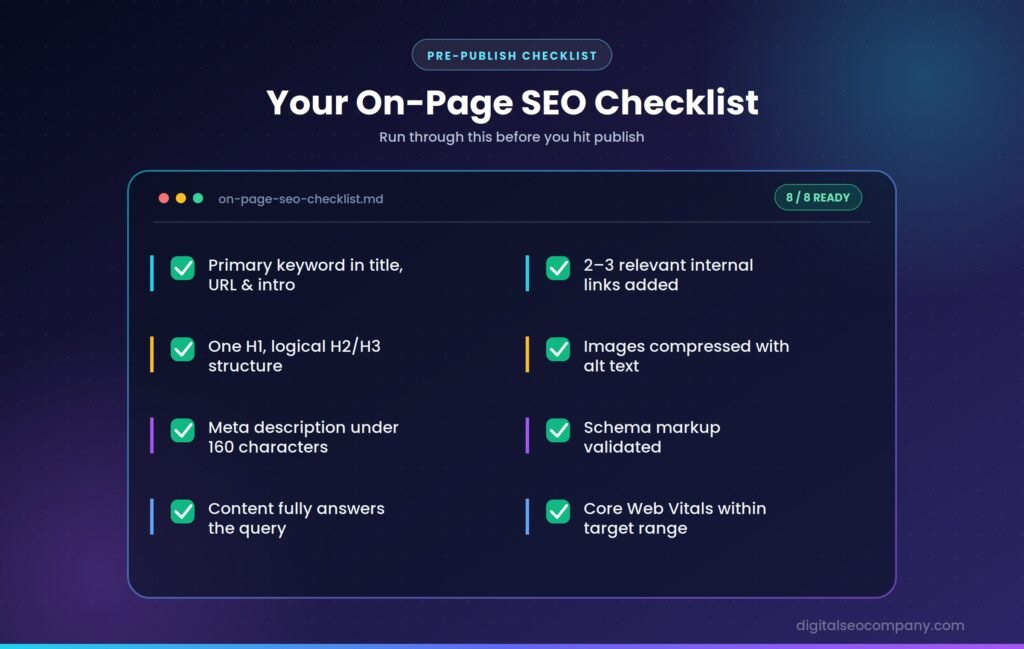
Use this as a pre-publish pass on every post:
- Primary keyword in the title tag, URL, and first 100 words
- One H1, logically nested H2s and H3s
- Meta description written as click-worthy ad copy, under 160 characters
- Content fully answers the query — no padding, no gaps
- Related entities and semantic terms covered, not just the exact-match keyword
- 2–3 internal links to relevant existing pages
- Images compressed, with descriptive file names and alt text
- Schema markup added and validated
- Core Web Vitals checked (LCP, INP, CLS within targets)
- Mobile rendering checked
- Author/byline and credible sourcing visible for E-E-A-T
Common On-Page SEO Mistakes to Avoid
- Keyword stuffing — repeating the exact phrase unnaturally instead of covering the topic broadly
- Duplicate or near-duplicate title tags and meta descriptions across pages
- Thin content that mentions a topic without actually answering the underlying question
- Orphan pages with no internal links pointing to them
- Ignoring page speed because “the content is good enough” — it isn’t, if the page doesn’t load
- Treating on-page SEO as a one-time task instead of revisiting and refreshing key pages periodically
Optimizing On-Page Content to Get Cited in AI Overviews
This is where on-page SEO and Generative Engine Optimization (GEO) now overlap directly. AI Overviews and chat-based answer engines don’t rank whole pages — they extract self-contained passages. To be one of those passages:
- Answer first, explain second. Open each major section with a 1–2 sentence direct answer to the question the heading implies, then expand with detail.
- Make each section stand alone. Write as if a single paragraph could be lifted out of context and still make complete sense — because that’s exactly what happens when it’s cited.
- Use clean Q&A formatting. FAQ sections written as tight, direct answers are among the most citation-friendly formats that exist, since they’re already structured the way an AI answer looks.
- Cite your own sources. Linking out to authoritative, original sources signals trustworthiness and models the behavior these systems reward — pages that cite well-sourced information are more likely to be cited themselves.
- Show clear authorship. A visible author name, credentials, and evidence of first-hand expertise matter more now that trustworthiness has become a gating factor, not a nice-to-have.
It’s worth setting expectations correctly here: ranking #1 on Google no longer guarantees an AI citation, and the overlap between top-ranking pages and AI-cited sources has narrowed substantially. On-page SEO and GEO increasingly need to be treated as related but distinct disciplines — get the on-page fundamentals right, then layer the citation-specific formatting on top.
Frequently Asked Questions
What is on-page SEO in simple terms?
- On-page SEO is everything you optimize directly on a webpage — content, titles, headers, links, and structure — to help it rank higher and be understood correctly by search engines and AI systems.
What’s the difference between on-page and technical SEO?
- On-page SEO focuses on relevance and clarity (content, tags, structure). Technical SEO focuses on accessibility (crawlability, indexing, site architecture, speed). They overlap at points like Core Web Vitals but solve different problems.
How many words should an SEO-optimized blog post be?
- There’s no fixed word count. Content should be as long as it needs to be to fully answer the query without padding — competitive informational content often lands well over 1,000 words simply because that’s what full coverage requires.
Does on-page SEO still matter with AI Overviews taking over search?
- Yes — arguably more than before. AI systems still rely on well-structured, clearly written, properly tagged content to extract accurate answers. Poor on-page SEO makes a page both hard to rank and hard to cite.
What’s the single highest-impact on-page SEO factor?
- Content that fully and clearly answers search intent, paired with a logical header structure — because everything else (title tags, internal links, schema) exists to help search engines and AI systems recognize that the content already does this well.
Final Thought
On-page SEO isn’t a checklist you complete once — it’s the ongoing discipline of making every page as clear, complete, and machine-readable as possible. Get the foundation right — structure, clarity, depth, and trust signals — and both traditional rankings and AI citations follow from the same work, not separate ones.