
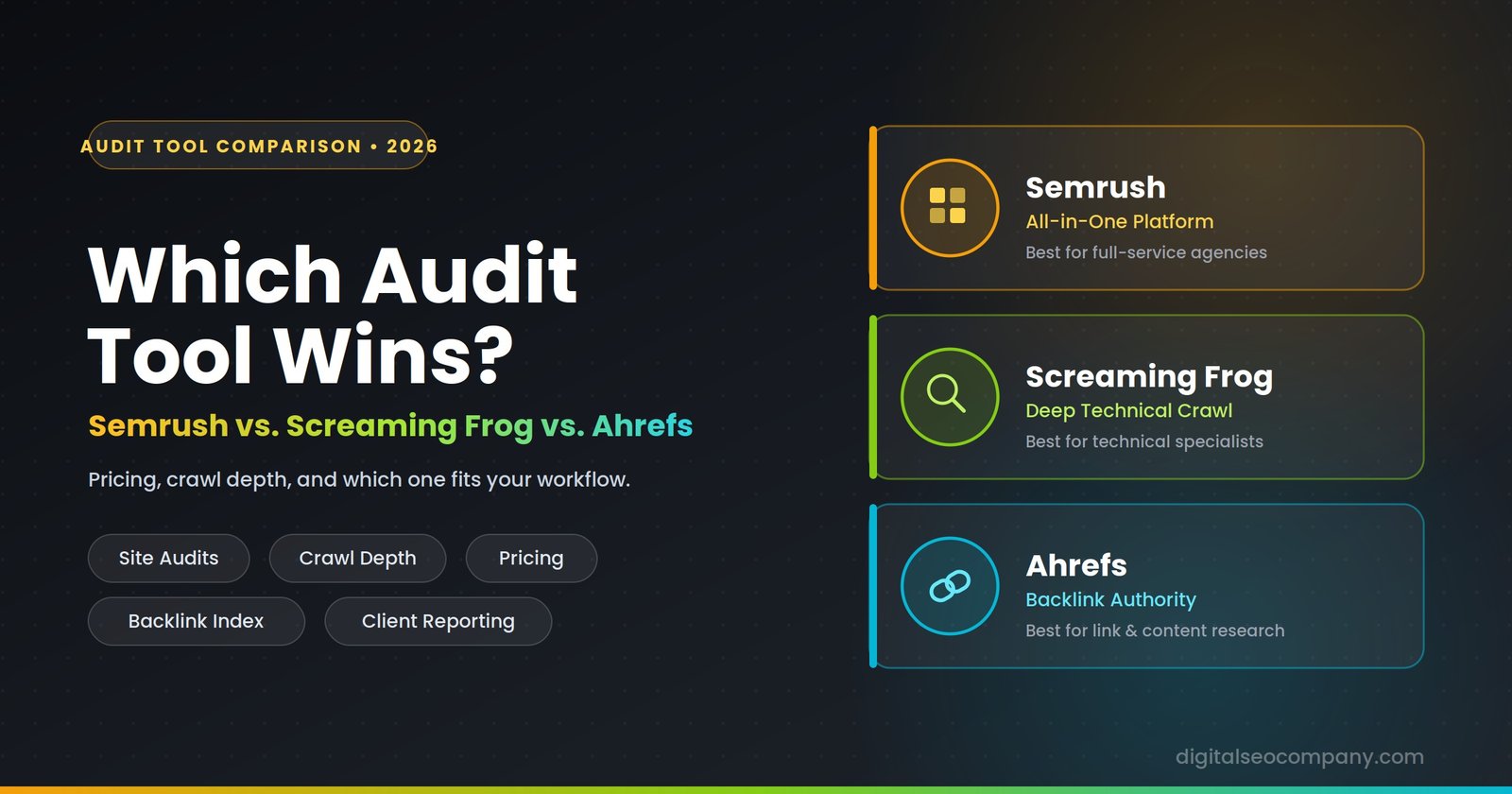
Semrush, Screaming Frog, and Ahrefs are the three most-used SEO audit tools in 2026, but they’re built for different jobs: Semrush is an all-in-one cloud platform that pairs technical audits with keyword and competitive data, Screaming Frog is a desktop crawler built purely for deep technical audits at the lowest cost, and Ahrefs is a cloud platform built around the industry’s strongest backlink index, with a technical audit layered on top. There’s no single “best” — the right one depends on whether you need an all-in-one workflow, the deepest raw crawl data, or the strongest link-analysis engine.
If you’re choosing between them for the first time, the short version is this: Semrush and Screaming Frog solve the most similar problem — technical site health — which is exactly why they get compared head-to-head so often. Ahrefs solves a genuinely different problem (link and content intelligence) that happens to include an audit feature. Here’s the honest breakdown of all three.
Why This Comparison Comes Up So Often
Every SEO practitioner eventually needs a way to systematically find what’s broken on a site — crawl errors, missing tags, redirect chains, duplicate content, slow pages. That’s the job a “site audit tool” does. But the three market leaders arrived at that job from completely different starting points: Screaming Frog was built specifically to crawl websites and expose raw technical data. Semrush grew from a keyword-research tool into a full SEO suite that added auditing along the way. Ahrefs grew from a backlink index into a full suite that did the same. That history still shows up in what each tool is actually best at today.
What Each Tool Actually Is
Semrush: the all-in-one platform
Semrush is a cloud-based SEO suite where site auditing sits alongside keyword research, rank tracking, competitive analysis, content tools, and PPC data — all in one login, one dashboard, one client-facing report. The Site Audit tool runs 130+ technical checks and integrates directly with the rest of the platform, so a technical issue you find can be tied back to the keyword or page it’s affecting without switching tools.
Where it wins: if you’re doing SEO work end-to-end — audits, keyword strategy, content planning, and reporting to a client or stakeholder — Semrush covers all of it without needing to stitch together multiple subscriptions. Its Site Health Score gives clients a single trackable number that improves audit-over-audit, which is genuinely useful for demonstrating progress in a recurring engagement rather than just handing over a list of fixed errors.
Where it’s weaker: the platform is large, and that breadth means a steeper learning curve for someone who only wants a technical crawl. Cost also scales with the number of pages you’re auditing, since crawl limits are tied to your plan tier.
Screaming Frog: the technical deep-dive
Screaming Frog SEO Spider is a desktop application, not a cloud platform — you install it and run crawls locally. It does one job and does it about as thoroughly as any tool on the market: crawling every URL, every link, every tag, every redirect, and handing you the raw data with no interpretation layered on top.
Where it wins: raw technical depth and cost efficiency. It’s licensed as a flat annual fee rather than priced by page volume, so your crawl size is limited by your own computer’s power, not by what tier you’re paying for. Custom extraction — pulling specific data via XPath, CSS selectors, or regex during a crawl — is a feature that specialists rely on and that neither Semrush nor Ahrefs matches in the same way. For a technical specialist who wants full control over exactly what gets crawled and how, nothing else in this comparison matches it.
Where it’s weaker: it’s audit-only. There’s no backlink index, no keyword research, no rank tracking, and no built-in client-reporting layer — you’re expected to export the data and build your own report, or pair it with another tool.
Ahrefs: the link and content authority
Ahrefs is a cloud platform best known for having one of the most comprehensive backlink indexes in the industry — a dataset that takes years to build and is genuinely difficult for a newer tool to replicate. Its Site Audit feature is a real, capable technical crawler with strong JavaScript rendering support, but it sits alongside the backlink and content-research tools as the platform’s primary draw. Content Explorer, its content-research tool, is often cited as a strong reason to keep an Ahrefs subscription even alongside another primary audit platform.
Where it wins: competitive link research, content gap analysis, and technical audits on JavaScript-heavy sites where rendering matters.
Where it’s weaker: as a dedicated audit tool it’s arguably the least differentiated of the three — you’re paying primarily for the backlink index, with the audit feature as a strong bonus rather than the main event. Its audit crawls also run on a credit system rather than a flat page count, which needs watching on larger sites.
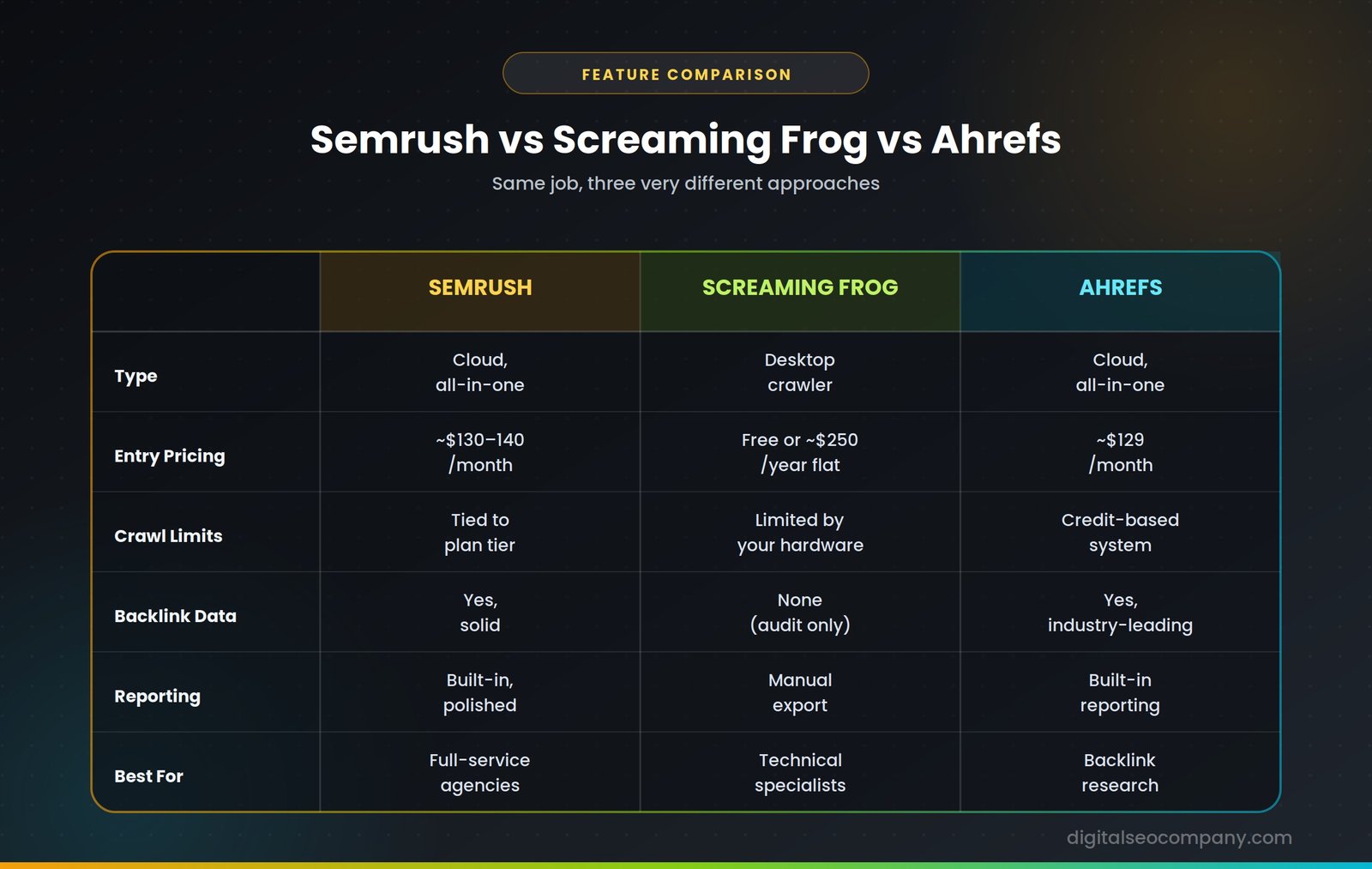
Semrush vs. Screaming Frog vs. Ahrefs: Feature Comparison
| Semrush | Screaming Frog | Ahrefs | |
| Type | Cloud, all-in-one | Desktop crawler | Cloud, all-in-one |
| Primary strength | Integrated audit + keyword + competitive suite | Deepest raw technical crawl | Strongest backlink index |
| Entry pricing (2026) | ~$129.95–139.95/month | Free (500 URLs) or ~£199/year (~$250) flat | ~$129/month |
| Crawl limits | Tied to plan tier (e.g. 100K pages/project on entry tier) | Limited by your hardware, not the license | Credit-based (e.g. ~10K credits/month on entry tier) |
| Backlink database | Yes, solid | No | Yes, industry-leading |
| Keyword research | Yes, strong | No | Yes, strong |
| Client reporting | Built-in, polished | Manual export required | Built-in |
| Best for | Agencies/consultants doing full-service SEO | Dedicated technical audits at scale | Backlink-heavy competitive research |
Semrush vs. Screaming Frog: The Direct Comparison
Since these two get compared most often, it’s worth answering directly: if you only need technical audits and nothing else, Screaming Frog is the cheaper, deeper option. Its flat licensing means a large site costs the same to crawl as a small one, and the raw data it exposes is harder to get anywhere else.
Semrush wins when the audit isn’t the only thing you need. If you’re also tracking rankings, researching keywords, monitoring competitors, and sending a client a report that ties all of that together, running Screaming Frog alongside two or three other subscriptions usually ends up costing more — in both money and time — than one Semrush plan that does all of it.
A useful way to frame it: Screaming Frog is a specialist tool for a technical specialist. Semrush is a generalist platform for someone who owns the whole SEO relationship, not just the crawl.
Which Tool Fits Your Situation?
- Solo consultant or in-house marketer doing everything yourself → Semrush. The combined audit, keyword, and reporting workflow in one subscription is worth more than the savings from a cheaper single-purpose tool.
- Dedicated technical SEO specialist auditing large or complex sites → Screaming Frog. Nothing matches its depth and cost-per-crawl at scale, especially past 50,000+ pages.
- Agency doing heavy competitive and link-building work → Ahrefs, generally paired with a second tool for reporting and keyword tracking.
- Agency managing multiple clients across all three needs → a combination, not a single tool (see below).
The “Power Move”: Using More Than One Together
Most experienced practitioners don’t treat this as a strict either/or decision. A common, cost-effective setup pairs Screaming Frog for deep technical crawls with Semrush or Ahrefs for keyword tracking, competitive data, and client-facing reporting — getting the best of both without paying for three overlapping subscriptions. Running all three simultaneously is usually only worth it for larger agencies managing many clients at once; for a smaller team or solo operator, the overlap in features rarely justifies the extra cost.
What About Log File Analysis?
None of the three tools in this comparison natively does deep log file analysis — cross-referencing what Googlebot actually crawled against your site’s server logs, as opposed to what a simulated crawl finds. Screaming Frog offers a separate companion tool (the Log File Analyser) for this; Semrush and Ahrefs don’t. If log file analysis is a core part of your workflow — common on large enterprise sites where crawl budget is a real constraint — that’s typically a separate specialist tool (like Lumar or OnCrawl) layered on top of whichever primary platform you choose, not a reason to pick one of these three over another.
Common Mistakes When Choosing an Audit Tool
- Buying an all-in-one platform and never using the crawler properly — Semrush and Ahrefs’s cloud-based audits are strong, but a dedicated crawler like Screaming Frog still catches things a broader platform can miss on complex or very large sites
- Buying Screaming Frog expecting a full SEO platform — it’s audit-only by design; pairing it with a keyword/reporting tool isn’t optional if you need those functions
- Ignoring crawl limits until mid-project — Semrush and Ahrefs both cap crawl volume by plan tier or credits; know your site’s page count before committing to a plan
- Choosing based on price alone — the cheapest option is only cheap if it actually does the job you need; a $250/year tool that can’t produce a client report may cost more in manual work than a pricier all-in-one platform
How We Use This at Digital SEO Company
Our own technical SEO audits lean on Semrush as the core platform — it lets us combine the technical crawl with the keyword and competitive context a client actually needs to prioritize fixes, rather than handing over a raw list of errors with no strategic framing. For particularly large or JavaScript-heavy sites, we’ll bring in a dedicated crawl pass as a supplement, but the reporting and client relationship run through one consistent platform. It’s the same “specialist tool as a supplement, generalist platform as the backbone” approach outlined above.
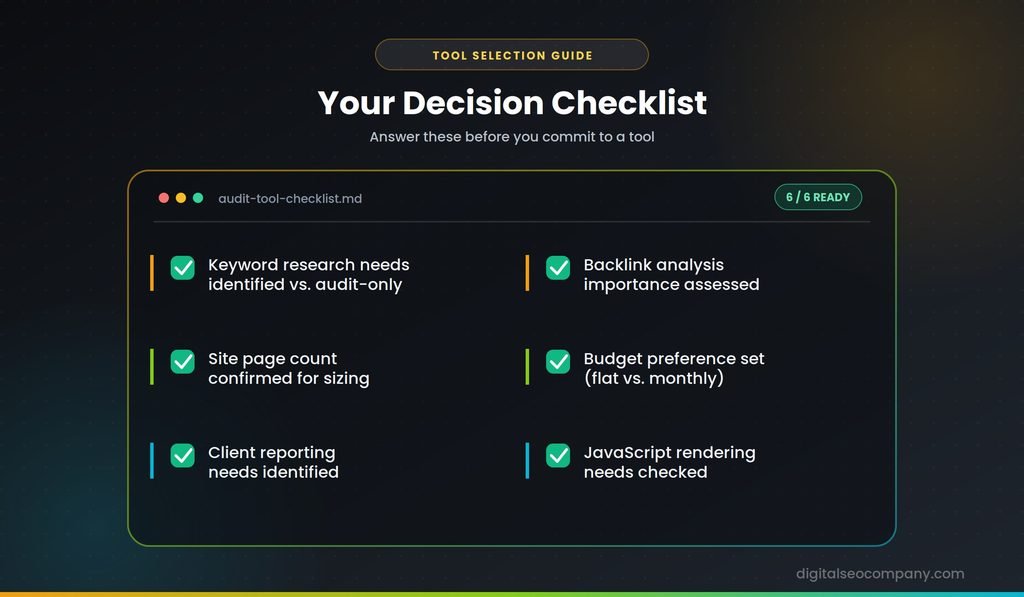
Checklist: Choosing Your Audit Tool
- Do you need keyword research and rank tracking alongside the audit, or just the audit itself?
- How many pages does your site (or your largest client’s site) actually have?
- Do you need client-facing reports built in, or are you comfortable exporting and building your own?
- Is backlink analysis a core part of your workflow, or a nice-to-have?
- Does your budget favor a flat annual cost (Screaming Frog) or a predictable monthly platform fee (Semrush/Ahrefs)?
- Are you auditing JavaScript-heavy sites that need strong rendering support?
Frequently Asked Questions
Is Semrush or Screaming Frog better for SEO audits?
- Screaming Frog offers deeper raw technical crawl data at a lower flat cost, making it the stronger choice for dedicated technical audits. Semrush is better when you need the audit integrated with keyword research, competitive tracking, and client reporting in one platform.
Can Screaming Frog replace Semrush?
- Only for the technical audit portion. Screaming Frog doesn’t include keyword research, rank tracking, or a backlink index, so it can’t fully replace an all-in-one platform if your workflow needs those features too.
Is Ahrefs better than Semrush for site audits?
- Ahrefs’ Site Audit is capable and handles JavaScript rendering well, but its main strength is its backlink index, not the audit feature itself. For audit-plus-keyword-research workflows, Semrush and Ahrefs are closely matched; the better choice usually comes down to whether backlink data or PPC/competitive data matters more to you.
Do professionals really use more than one of these tools?
- Yes — it’s common to pair Screaming Frog’s deep technical crawl with Semrush or Ahrefs’s reporting and keyword layer, rather than relying on just one tool or running all three redundantly.
What’s the cheapest way to get a real technical SEO audit?
- Screaming Frog’s free tier covers up to 500 URLs, which is enough for a genuine technical audit of a small site at no cost. Larger sites will need either the paid Screaming Frog license or a cloud platform plan.
Final Thought
There’s no universally “best” tool here — there’s a best tool for what you’re actually trying to do. If auditing is your whole job, Screaming Frog’s depth and flat pricing are hard to beat. If auditing is one piece of a broader SEO relationship with a client, an all-in-one platform like Semrush earns its subscription cost back in saved time. Pick based on the workflow you actually run, not the tool with the most features on paper. Contact us to will a free audit consultation.