
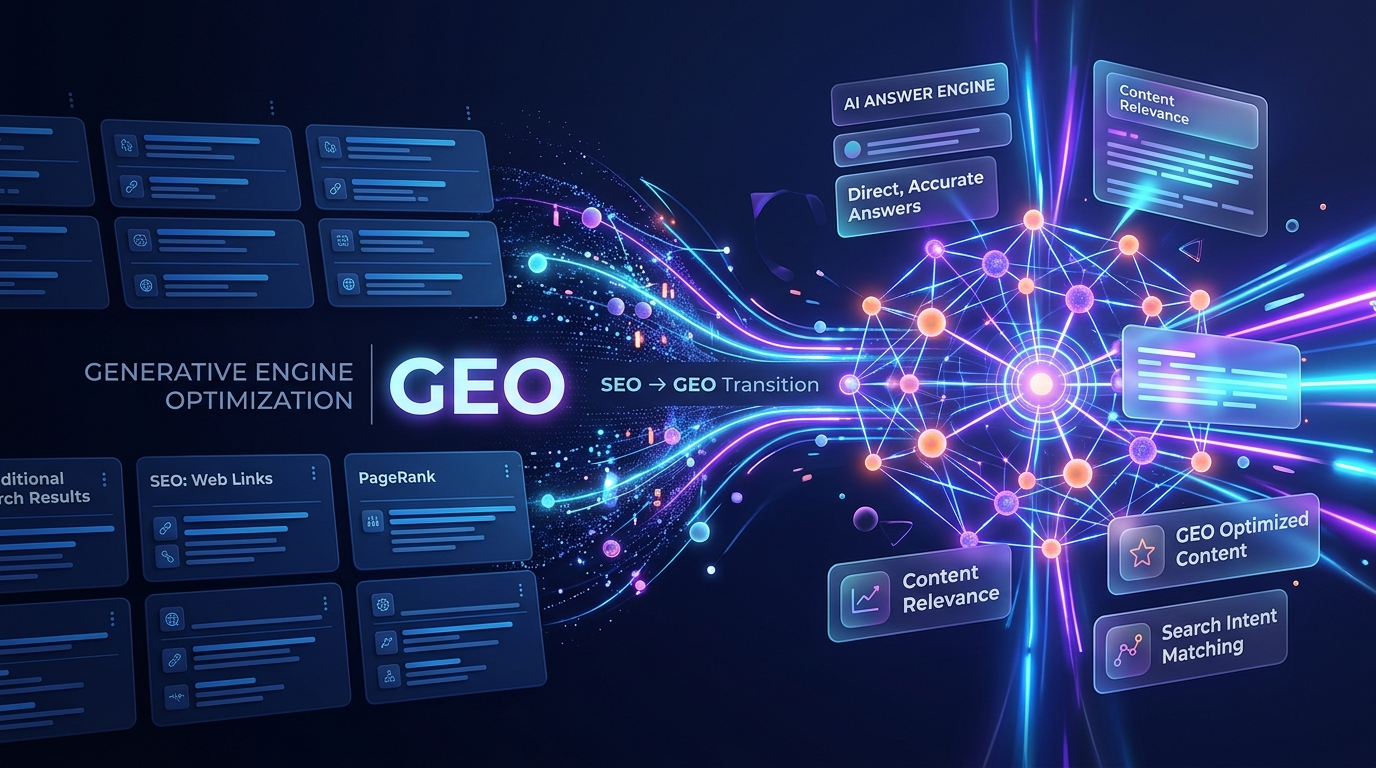
1. The Death of the “10 Blue Links” Era
For over two decades, SEO followed a predictable script: research keywords, build backlinks, publish content, rank on page one. That script still matters — but it no longer tells the whole story.
ChatGPT, Perplexity, Gemini, and Google’s AI Overviews have changed what “search” actually means. Instead of scanning ten blue links and clicking through, users are increasingly handed a synthesized answer on the spot — one that was assembled from a handful of sources the AI model decided to trust. Your site can rank #1 in traditional Google results and still be invisible in that synthesized answer if it wasn’t structured to be understood, extracted, and cited by an AI system.
That’s the gap Generative Engine Optimization (GEO) exists to close.
2. What is Generative Engine Optimization (GEO)?
Generative Engine Optimization (GEO) is the practice of structuring your website, content, and data so that AI search engines can understand, trust, and cite your brand as a primary source when answering user queries.
Where traditional SEO asks “how do I rank for this keyword,” GEO asks a different question: “how do I become the source an AI model chooses to quote?”
That distinction changes the entire approach:
| Topics | Traditional SEO | GEO |
| Primary goal | Rank for individual keywords | Get cited/quoted inside AI-generated answers |
| Core signal | Backlinks, on-page keyword relevance | Entity association, structured data, citation probability |
| Content style | Long-form, keyword-optimized | Fact-dense, directly extractable, unambiguous |
| Success metric | SERP position, organic clicks | Share of AI answer citations, brand mentions in LLM output |
| Machine reader | Googlebot (crawls and indexes) | LLM crawlers + retrieval systems (parse and synthesize) |
GEO doesn’t replace technical SEO — it’s built on top of it. A site with crawl errors, broken schema, or thin content will struggle in both worlds. But solid technical SEO alone no longer guarantees visibility once the answer layer sits between your content and the user.
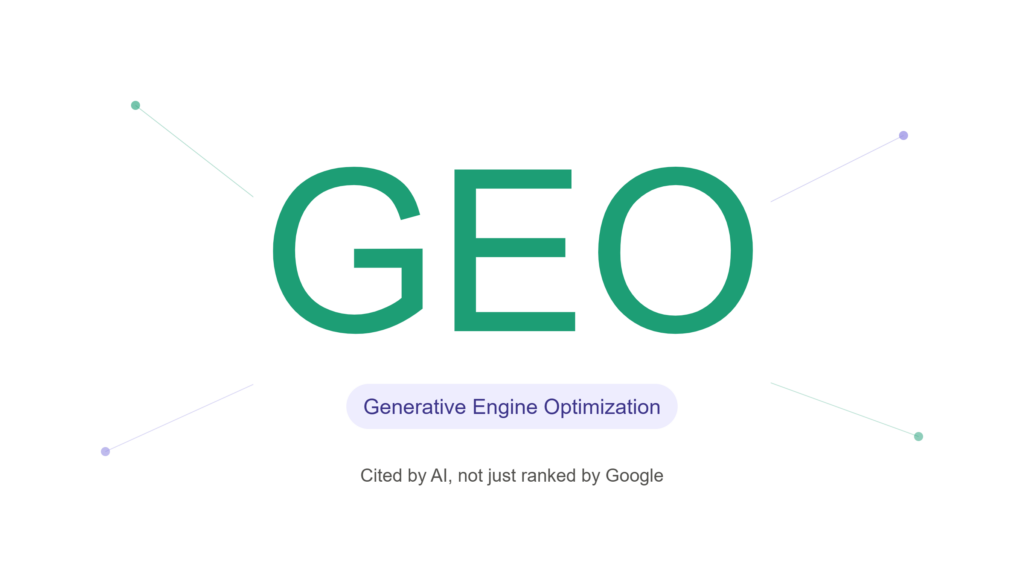
3. Why GEO Matters for Startups and Enterprise Brands Alike
Here’s the visibility shift in practical terms: when someone asks Perplexity “what’s the best technical SEO agency for SaaS startups,” the model isn’t running a live search-and-rank process the way Google’s classic algorithm does. It’s retrieving and reasoning over content it already trusts as accurate and well-structured. Your position #3 ranking on Google means very little in that moment if the AI model can’t clearly parse who you are, what you do, and why you’re credible.
This affects two groups differently, but neither can ignore it:
- Startups get a rare leveling effect — a well-structured, entity-clear site can out-compete a much larger, poorly-structured competitor for AI citations, the same way a lean site once out-ranked a bloated one in early Google.
- Enterprise brands risk the opposite problem: significant traditional SEO equity that doesn’t automatically transfer to AI visibility, because their content wasn’t built for machine extraction in the first place.
The Core Technical Requirements for a GEO-Friendly Site
- Structured Data & Semantic Markup — Explicit JSON-LD (Organization, Service, FAQ, Article, Product schema, depending on the page) gives AI crawlers unambiguous facts instead of forcing them to infer meaning from prose. If you haven’t audited your schema coverage recently, this is usually the fastest win.
- llms.txt Deployment — A dedicated, clean markdown file that gives LLMs a direct, noise-free summary of who you are, what you offer, and where your authoritative pages live — the AI-era equivalent of a well-built XML sitemap.
- Fact-Dense Prose — AI parsers extract and quote specific, well-bounded statements far more readily than marketing fluff. “We help SaaS companies fix indexing issues” is easy to quote. Three paragraphs of scene-setting before you say what you actually do is not.
4. Actionable Steps to Future-Proof Your Site for AI Search
Step 1: Audit your technical architecture for crawling blocks. Confirm that robots.txt isn’t inadvertently blocking AI crawlers (GPTBot, PerplexityBot, Google-Extended, and others), and that your XML sitemap and internal linking give both traditional and AI crawlers a clean path to your most important pages.
Step 2: Implement dedicated llms.txt configurations. Build a structured llms.txt file — and where relevant, per-section or multilingual variants — that gives AI models a direct, current summary of your site instead of forcing them to reconstruct it from scattered pages.
Step 3: Transition from generic keyword targeting to entity-based content mapping. Rather than writing one page per keyword, map your content around entities — your services, your niches, your named methodologies — and interlink them so both search engines and AI models can see the full picture of what you’re an authority on.
If you want a deeper walkthrough of any of these three steps, they’re each covered in more detail in our GEO services overview, including how we sequence the audit-to-implementation process for client sites.
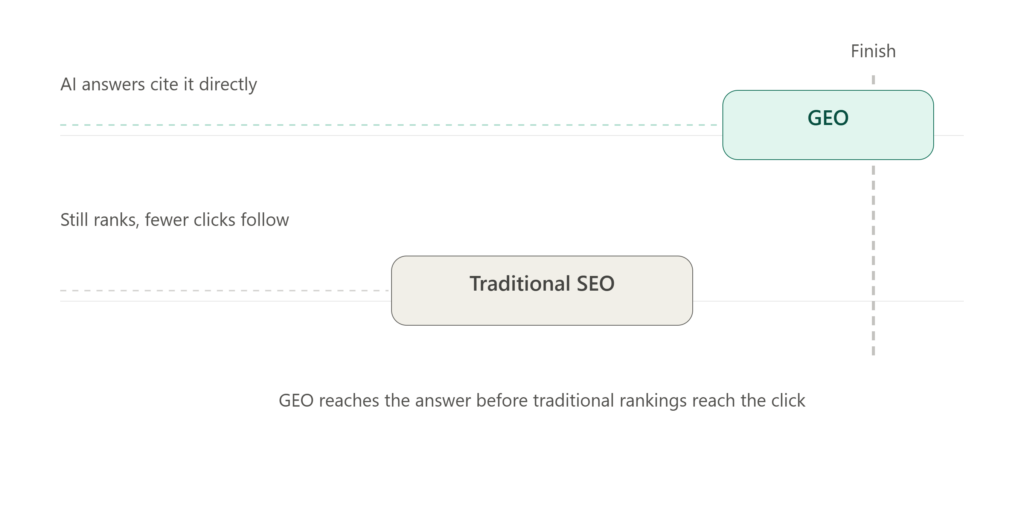
5. Ready to Show Up in the Answer, Not Just the Results Page?
Want to rank in AI Overviews before your competitors do? Every month you wait is a month of ChatGPT, Perplexity, and Gemini answers going to someone else’s brand instead of yours.
Explore Our GEO Services → Let our team deploy the structured data, llms.txt frameworks, and entity-based content architecture your site needs to get cited — not just crawled.