
Local SEO is the practice of optimizing a business’s online presence so it appears when nearby customers search for related products or services — primarily through Google’s Local Pack, Maps, and localized organic results. If your business serves a specific geographic area, local SEO is the highest-leverage marketing channel available: nearly half of all Google searches now carry local intent, and most people who search for something nearby on their phone visit a related business within a day. That’s not brand awareness — that’s a customer walking through the door.
Unlike traditional SEO, local SEO isn’t primarily won on your website. It’s won on your Google Business Profile, reinforced by reviews, citations, and local content — with your website playing a supporting role rather than the lead.
Why Local SEO Matters More Than Ever
Local search has shifted from a “nice to have” to the primary discovery channel for location-based businesses. A few things worth knowing:
- Local intent now shows up in a large share of all Google searches — location-based queries like “near me,” “[service] in [city],” or a plain local search from a mobile device
- The majority of people who search for something nearby on a smartphone visit a related business within 24 hours — local search converts to real-world action faster than almost any other channel
- AI Overviews and AI assistants like ChatGPT and Gemini now trigger for a significant share of local queries, pulling directly from Google Business Profile data — meaning your profile is no longer just a map listing, it’s a data source AI systems read from directly
How Google Ranks Local Results: Relevance, Distance, Prominence
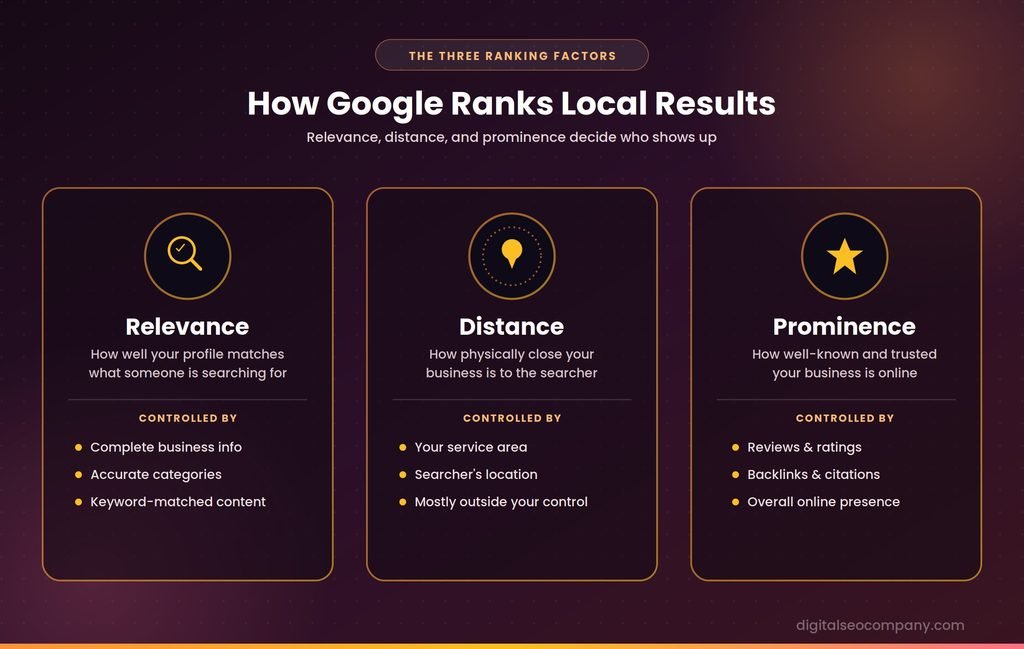
Google’s own guidance is refreshingly simple: local rankings come down to three factors.
- Relevance — how well your business profile and content match what the searcher is looking for
- Distance — how physically close your business is to the searcher (or the location in their query)
- Prominence — how well-known and trusted your business is, based on reviews, links, citations, and overall online presence
Distance is largely outside your control — you can’t move closer to every searcher. Relevance and prominence, however, are almost entirely within your control, which is where local SEO effort should concentrate.
The Core Elements of Local SEO
1. Google Business Profile (GBP) Optimization
Your Google Business Profile is the single most influential local ranking asset — industry surveys consistently put GBP signals at around a third of total local ranking weight, ahead of any other factor group.
- Primary category carries more weight than almost anything else on your profile — choose the narrowest, most accurate category available (a personal injury attorney should use “Personal Injury Attorney,” not the generic “Law Firm”)
- Add relevant secondary categories to capture adjacent searches (a bakery that also serves coffee should add “Coffee Shop”)
- Keep hours accurate — outdated hours are one of the most common causes of negative reviews and directly affect when your profile even surfaces
- Post regularly (updates, offers, events) — posts don’t directly move map pack position, but they lift click-through and keep your profile looking active, which matters for both users and AI systems reading your profile as a live dataset
- Add complete services, products, and Q&A content — this is exactly the raw material AI Overviews pull from when summarizing local businesses
- Use real, recent photos — Google and AI systems increasingly treat photo recency as an E-E-A-T signal of an active, legitimate business
2. Reviews and Reputation
Reviews are consistently the second most influential local ranking factor after GBP itself.
- Velocity beats volume — a steady stream of reviews over time outperforms a single burst of 50 reviews followed by silence
- Respond to every review, positive and negative — a professional response to a negative review often does more for trust than the review itself
- Some research suggests AI platforms rarely name a business in local recommendations below roughly 150 reviews per location — treat that as a directional target, not a hard rule, but it underlines that review volume increasingly affects AI visibility, not just star rating
3. NAP Consistency and Local Citations
NAP stands for Name, Address, Phone — and it needs to match exactly across your Google Business Profile, your website, and every directory you’re listed on.
- Even a minor variation (a suite number present in one listing and missing in another) can fragment how Google recognizes your business as a single entity
- Get listed in reputable, relevant directories for your industry and location — data aggregators, chamber of commerce listings, and industry-specific directories all count as citations
- Audit citations periodically; inconsistent data actively suppresses local visibility, it doesn’t just fail to help
4. Location-Specific Content and Landing Pages
- Every location or service area you serve should have its own dedicated page — not a placeholder with two sentences, but real content addressing that specific market
- Use local landmarks, neighborhoods, and genuinely local language naturally, not just the city name stuffed into a title tag
- Structure H1s and H2s around real local search intent — a page opening with the actual problem local customers have tends to outperform generic service copy with a city name swapped in
5. Local Link Building
Off-page SEO shifts in local search — instead of chasing high-authority links from anywhere, you want local relevance.
- Join your local Chamber of Commerce — it almost always includes a citation and often a link
- Sponsor local events, teams, or nonprofits for natural, relevant local backlinks
- Get featured in local “best of” list posts and community publications
- The same link-quality principles from general link building still apply — see our [backlinks guide] for what separates a valuable link from a wasted one — but for local SEO, relevance to your specific geographic community matters more than raw domain authority
6. On-Page Local SEO
- Use location-specific title tags and meta descriptions (“Plumber in Austin, TX,” not just “Plumber”)
- Implement LocalBusiness schema markup with your NAP, hours, and service area
- Make sure your website’s NAP matches your GBP exactly
- Keep the technical foundation solid — a slow or poorly indexed site undermines every other local signal you build, which is exactly what our on-page SEO guide and technical SEO guide cover in depth
7. Mobile Optimization
The large majority of local searches happen on mobile devices, often from someone actively out and looking for somewhere to go right now.
- A slow, non-responsive site directly increases bounce rate and signals poor experience to Google
- Click-to-call buttons, embedded maps, and fast-loading contact info aren’t optional polish — they’re core to converting local search traffic
- Page speed matters more here than almost anywhere else in SEO, since local searchers are frequently on the move with limited patience
Local Ranking Factors: Where the Weight Falls
| Signal group | Approximate weight | What it covers |
| Google Business Profile | ~32% | Categories, completeness, posts, photos |
| On-page signals | ~19–33% | Location pages, schema, internal linking |
| Reviews | ~16% | Volume, velocity, response rate |
| Links/citations | ~15–24% | Local backlinks, directory citations |
| Behavioral signals | ~8% | Clicks, calls, direction requests |
| Citation consistency | ~7% | NAP accuracy across the web |
Exact percentages vary across industry surveys (Whitespark, BrightLocal, and others each weight signals slightly differently), but the ranking of what matters most has stayed consistent: GBP first, then reviews and on-page content, with citations and behavioral signals reinforcing the rest.
How to Run a Local SEO Audit
- Audit your GBP — check category accuracy, completeness, hours, and recent activity
- Check NAP consistency — search your business name and compare listings across your top directories
- Review your competitors’ profiles — search your top keywords in an incognito Maps session and compare their primary category, review count, and photos to yours
- Test mobile experience — load your site on an actual phone and time how long it takes to find your phone number
- Check for LocalBusiness schema — validate it with Google’s Rich Results Test
- Review your review response rate — aim for a response to every review within a few days
Local SEO Checklist
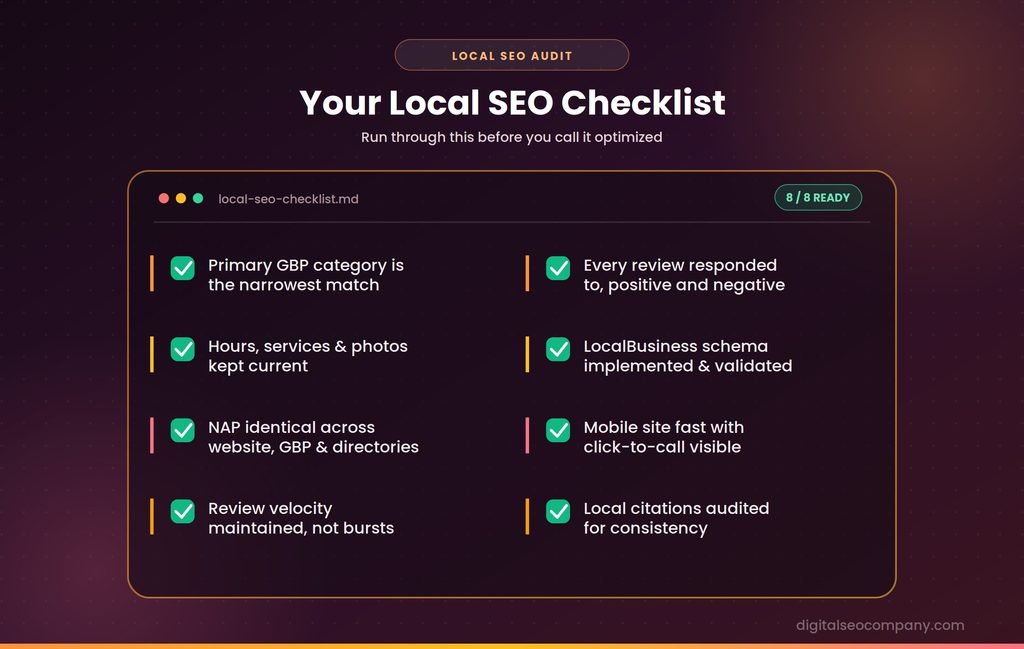
- Primary GBP category is the narrowest accurate match
- Hours, services, and photos kept current
- NAP identical across website, GBP, and directories
- Review velocity maintained — steady flow, not one-time bursts
- Every review responded to, positive and negative
- Dedicated landing page for each location/service area
- LocalBusiness schema implemented and validated
- Mobile site loads fast with visible click-to-call and map
- Local citations audited for consistency
- At least one active local link-building effort underway (sponsorship, chamber, local press)
Common Local SEO Mistakes
- Choosing the broadest category instead of the narrowest accurate one — this is consistently one of the highest-impact mistakes on a GBP profile
- Letting NAP drift out of sync across directories after a move, rebrand, or phone number change
- Treating GBP as a one-time setup instead of an actively maintained profile — inactive profiles lose visibility over time
- Generic, thin location pages that just swap the city name into otherwise identical content
- Chasing reviews in bursts around a promotion instead of building a steady, ongoing flow
- Ignoring mobile page speed while optimizing everything else
AI Based Local SEO and AI Overviews
Local search is one of the categories most reshaped by AI Overviews and AI assistants, because these systems lean heavily on structured, verifiable business data rather than open-web content.
- Your GBP is now an AI data source, not just a map listing. ChatGPT, Gemini, and Google’s own AI Overviews increasingly pull business details directly from Google Business Profile data when answering local queries.
- Citations are the new backlinks for AI visibility. Consistent, accurate mentions across directories and local publications feed AI systems’ confidence in your business’s identity and legitimacy — inconsistent data does the opposite.
- Review depth signals trustworthiness to AI systems, not just star rating — detailed, recent reviews mentioning specific services give AI models concrete material to summarize accurately.
- Structured data closes the gap. LocalBusiness schema gives AI systems an unambiguous, machine-readable version of your NAP, hours, and services — reducing the chance of an AI system guessing wrong or citing an outdated source instead of you.
Frequently Asked Questions
What is local SEO in simple terms?
- Local SEO is optimizing your online presence — primarily your Google Business Profile, reviews, and location-specific content — so your business appears when nearby customers search for what you offer.
What’s the most important local SEO ranking factor?
- Google Business Profile signals carry the most weight, generally estimated at around a third of total local ranking influence, with primary category selection being one of the single highest-impact choices within it.
How many reviews do I need for local SEO?
- There’s no official minimum, but review velocity (a steady flow over time) matters more than hitting any specific number. Some research points to roughly 150 reviews per location as a threshold where AI platforms begin reliably naming a business in recommendations.
Do I need a website for local SEO, or is Google Business Profile enough?
- You can technically rank in the Local Pack with just a GBP listing, but a fast, mobile-friendly website with location pages and proper schema markup reinforces relevance and gives you organic visibility beyond the map pack alone.
Does local SEO work for AI Overviews and AI search?
- Yes, and it’s becoming more important there, not less. AI Overviews pull heavily from Google Business Profile data and citation consistency, so the same fundamentals that win the map pack — accurate GBP, active reviews, and consistent NAP — now also determine AI visibility.
Final Thought
Local SEO rewards consistency more than any other branch of SEO — a complete, actively maintained Google Business Profile with a steady flow of reviews will outperform a technically perfect website with a neglected profile every time. Get the fundamentals right, keep them current, and both the map pack and AI search will keep pointing customers your way.