
Backlinks are links from other websites that point to yours, and they remain one of Google’s top-three ranking factors in 2026. Each one acts as a vote of confidence — the more relevant and authoritative the linking site, the more trust and ranking power it passes to your page. But not all votes count equally. A single link from a respected, topically relevant publication can outweigh hundreds of low-quality ones, and links built the wrong way can actively suppress your rankings instead of helping them.
Backlinks used to be a numbers game. In 2026, they’re a trust game — and that shift matters even more now that AI systems like Google AI Overviews, ChatGPT, and Perplexity decide who gets cited based partly on how a site is referenced and talked about across the web, not just how many links point to it.
Why Backlinks Still Matter in 2026
Search engines can’t personally vouch for a website’s credibility, so they infer it from how other sites treat it. When independent, relevant websites link to your content, that’s a signal no one can fake at scale as easily as on-page content.
A few things worth knowing about how much backlinks still weigh:
- Top-ranking pages tend to have significantly more backlinks than pages sitting in positions two through ten — Backlinko’s ranking studies put the multiple at roughly 3.8x for the #1 spot.
- Most content never gets linked to at all — Backlinko’s research also found that the vast majority of blog posts have zero external links, which is exactly why a genuinely link-worthy page stands out so sharply.
- Google has repeatedly confirmed backlinks remain among its most important ranking signals, even as AI and semantic understanding play a bigger role in evaluating content.
The takeaway: backlinks aren’t going away, but the bar for what counts as a good one keeps rising.
How Google Evaluates a Backlink
Google doesn’t just count links — it evaluates the full context around each one:
- Authority of the linking domain — how trusted and established the site is
- Relevance — whether the linking site’s topic actually relates to yours
- Placement — a link inside the body of an article carries more weight than one buried in a footer or sidebar
- Anchor text — the clickable words used, which help confirm what the linked page is about
- Surrounding content — whether the link sits in genuinely useful, editorial content or in a spun, low-value page built purely to host links
A relevant link from a smaller, niche site will often outperform a high-authority link from a completely unrelated industry — relevance has become a requirement, not a bonus.
Types of Backlinks: Dofollow, Nofollow, Sponsored & UGC
Not every link is meant to pass ranking authority, and Google expects sites to label them correctly using the rel attribute:
| Attribute | Meaning | Example use |
| Dofollow (default) | Passes authority and counts as an editorial endorsement | A journalist naturally links to your research in an article |
| rel=”nofollow” | Tells Google not to pass ranking credit | Untrusted or unverified links |
| rel=”sponsored” | Marks paid or advertising links | Sponsored posts, paid placements |
| rel=”ugc” | Marks user-generated content links | Forum posts, blog comments, Reddit/Quora links |
Misusing these tags — or not using them at all — is one of the more common technical mistakes in a link profile. If you run sponsored content or guest posts with paid placement, tagging them correctly protects your site from spam-policy issues.
What Makes a Backlink “High-Quality”
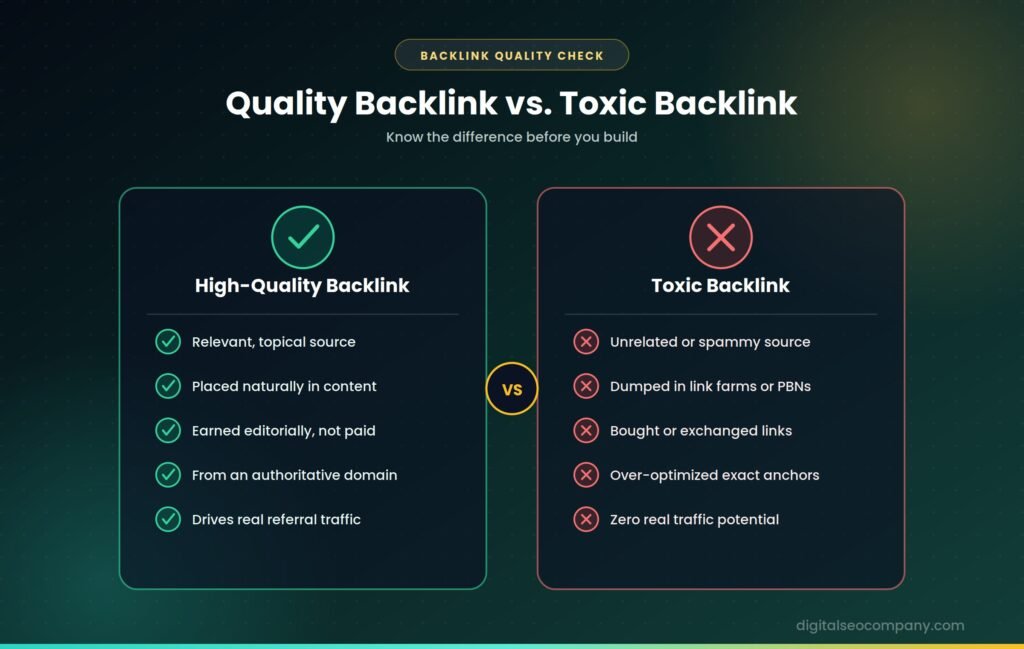
Before pursuing any link, ask whether it passes this test:
- Relevance — does the linking site relate to your niche or audience?
- Authority — is the domain established and trusted, not a thin, purpose-built site?
- Context — is the link placed naturally inside useful content, not dropped into an unrelated list?
- Traffic potential — could a real person actually click it and land on your site?
- Earned, not purchased — did it exist because your content deserved it, not because you paid for placement?
A link that fails most of these isn’t worth chasing, even if the metrics look impressive on a backlink checker.
Toxic and Spammy Backlinks: What to Avoid
Certain link types create real risk instead of ranking benefit:
- Paid links without disclosure — buying links is against Google’s spam policies and, when detected, the links are typically just ignored rather than passing any value; in more aggressive cases it can trigger a manual action
- Private blog networks (PBNs) — clusters of sites built purely to funnel links to a “money site”
- Link farms and low-quality directories — mass submissions with no editorial standard
- Excessive reciprocal linking (“I’ll link to you if you link to me”) — fine occasionally between genuinely related sites, risky as a strategy
- Spun or AI-mass-produced content hosting your link — thin, repetitive content built only to insert backlinks
- Over-optimized anchor text — the exact same keyword-rich anchor used repeatedly looks manipulative
Modern spam-detection systems (Google’s SpamBrain and its successors) are built to recognize these patterns automatically. In most cases Google simply devalues the link rather than penalizing the whole site — but why take the risk when earned links compound in value over time and manipulated ones plateau immediately? You can assess your backlinks by doing a backlink audit.
Proven Link-Building Strategies That Work in 2026
- Digital PR — pitch original data, research, or expert commentary to journalists and industry publications
- Guest posting — contribute genuinely useful articles to relevant, reputable sites in your niche (quality over volume)
- Broken link building — find dead links on relevant sites and suggest your content as the replacement
- Skyscraper technique — find content that already attracts many links, then create something more current, complete, or better designed, and reach out to the same linkers
- Unlinked mention reclamation — find places your brand is already mentioned without a link, and politely ask for one
- Resource page outreach — get listed on curated “best tools” or “best resources” pages in your industry
- Expert-quote platforms — respond to journalist queries (HARO-style platforms) with genuine expertise to earn links from news and industry sites
- Original research and data studies — publish something no one else has, giving other sites a reason to cite you as the source
- Competitor backlink analysis — use tools like Ahrefs or Semrush to see who links to competitors and pursue the same relevant sources
- Internal linking — the one link-building lever you fully control; it doesn’t replace external backlinks, but it distributes authority across your own site and strengthens topical clusters
Vary your approach. Leaning on a single tactic (guest posting alone, for example) tends to look unnatural to Google over time — a diversified, natural-looking link profile performs better and lasts longer.
Anchor Text Best Practices
The clickable text of a link tells search engines what the destination page is about — but overusing exact-match keywords is a red flag.
- Branded anchors (“Digital SEO Company“) — the safest, most natural type
- Natural/generic anchors (“click here,” “this guide”) — common in organic linking
- Partial-match anchors (“guide to on-page SEO“) — descriptive without being an exact keyword match
- Exact-match anchors (your precise target keyword) — use sparingly; overuse is one of the clearest manipulation signals Google watches for
A healthy anchor text profile is varied and mostly natural-sounding, not built around a single optimized phrase.
Auditing and Monitoring Your Backlink Profile
- Check Google Search Console’s Links report regularly — it’s free and shows exactly what Google sees
- Use a third-party tool (Ahrefs, Semrush, Moz) for deeper referring-domain analysis and competitor comparisons
- Track referring domains, not just total backlinks — Google weighs the diversity of unique linking sites more heavily than raw link count
- Disavowing links is rarely necessary — reserve it for cases of clear negative SEO attacks or a failed past campaign, not as routine maintenance
Backlinks and AI Overview Citations
This is where backlinks intersect directly with Generative Engine Optimization (GEO). AI Overviews and chat-based answer engines don’t just crawl links — they weigh how consistently and credibly a brand is referenced across the web.
- Brand mentions matter alongside links. Being talked about by name on relevant, trustworthy sites — even without a link every time — builds the kind of consistent authority signal that AI systems use to decide who to cite.
- Editorial endorsement outperforms volume. A handful of links from sites that clearly chose to reference you (not paid placements) signals genuine trust, which both traditional rankings and AI citation systems reward.
- Community platforms count more than they used to. Being organically referenced in places like Reddit or Quora threads — by users, not your own marketing account — is difficult to manufacture and increasingly treated as a real trust signal.
- Original, citable content earns both. A page built around real data, a genuine framework, or a clear original insight is what other sites and AI systems want to reference — because there’s something specific and attributable to point to.
The practical implication: don’t build backlinks and pursue AI citations as two separate efforts. The same asset — original, well-sourced, genuinely useful content — is what earns both.
Backlink Checklist
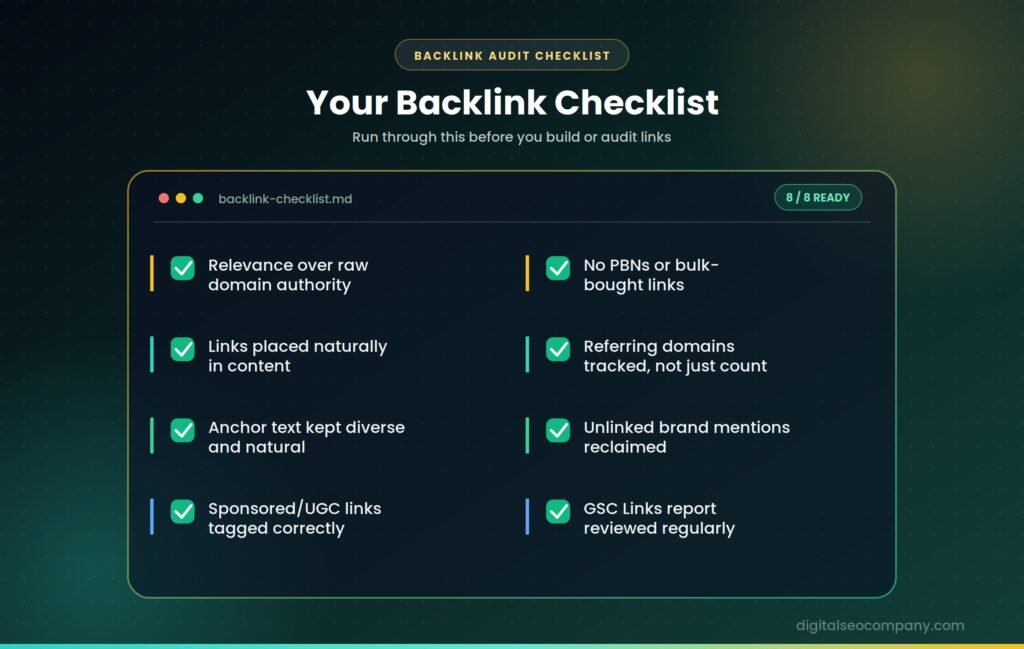
- Prioritize relevance over raw domain authority
- Confirm links sit naturally inside editorial content, not link lists
- Diversify anchor text — mostly branded/natural, exact-match used sparingly
- Tag sponsored and UGC links with the correct rel attribute
- Avoid PBNs, link farms, and bulk-purchased links
- Track referring domains, not just total link count
- Reclaim unlinked brand mentions
- Build at least one original, citable asset (data, research, tool, or framework)
- Review your GSC Links report on a regular schedule
Common Backlink Mistakes to Avoid
- Chasing volume over relevance — 100 unrelated links won’t outperform 5 relevant ones
- Ignoring anchor text diversity — repeating the same exact-match phrase looks manufactured
- Buying links without understanding the risk — it’s against Google’s guidelines and the links are frequently just ignored, wasting the spend
- Never auditing your profile — toxic links from negative SEO attacks or old campaigns can sit unnoticed for years
- Treating internal linking as an afterthought — it’s free, fully controllable, and directly supports the external links you do earn
- Building links but never producing anything worth linking to — link building without a genuinely link-worthy asset behind it rarely compounds
Frequently Asked Questions
What is a backlink in simple terms?
- A backlink is a link from another website pointing to yours. Search engines treat it as a vote of confidence — the more relevant and trustworthy the linking site, the more it can help your rankings.
How many backlinks do I need to rank?
- There’s no fixed number. A handful of highly relevant, authoritative links can outperform hundreds of weak ones. Focus on the quality and relevance of each link rather than hitting a target count.
Are backlinks still important with AI Overviews and AI search?
- Yes. AI systems weigh how consistently and credibly a brand is referenced across the web, which overlaps heavily with strong backlink and mention profiles. Original, citable content tends to earn both traditional links and AI citations.
Can backlinks hurt my SEO?
- Yes — low-quality, purchased, or spam links can suppress rankings, though Google’s modern systems more often simply ignore manipulative links than penalize the whole site. It’s still safer to build links that would exist naturally.
Do I need to disavow bad backlinks?
- Rarely. Disavowing is meant for clear cases of negative SEO or a failed past link campaign — not routine cleanup. In most situations, Google’s own systems already discount low-quality links automatically.
Final Thought
Backlinks haven’t lost their power in 2026 — they’ve become harder to fake and easier for search engines (and AI systems) to verify. The sites that win aren’t the ones with the most links; they’re the ones whose content genuinely deserves to be referenced, cited, and talked about.