
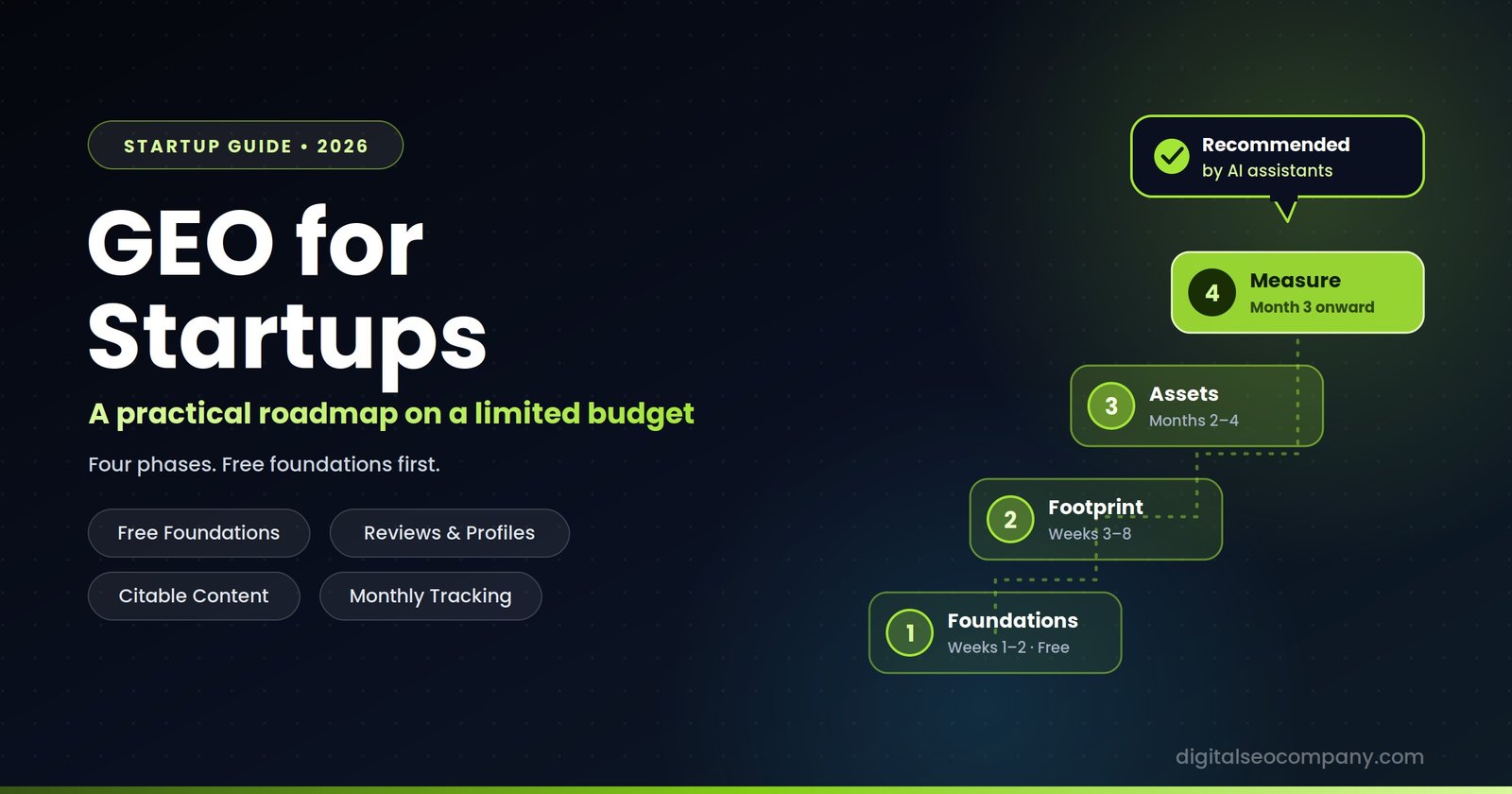
For a startup, generative engine optimization (GEO) comes down to one job: giving AI systems enough consistent, verifiable evidence that your company exists, what it does, and who it’s for — so they can recommend you when a buyer asks. On a limited budget, the order of work matters more than the amount: fix the free foundations on your own site first, then build a small but consistent third-party footprint, then create a few genuinely citable assets, and measure monthly. Most of the spend that tends to be wasted in GEO Services goes to the opposite sequence — publishing blog posts before the basics are in place.
This roadmap is written for founders and small teams deciding what to do themselves, what to delay, and when paying a specialist actually makes sense. For a refresher on how GEO relates to SEO and AEO, see our GEO vs. AEO vs. SEO comparison.
What the Data Says (and a Caveat)
A caveat first: most published GEO statistics come from companies that sell AI-visibility tracking, and nearly all of them are correlations, not proof of cause. Treat the numbers below as directional. With that in mind, the same pattern shows up repeatedly:
- Third-party sources dominate AI answers. AirOps, analyzing a very large set of citations, found roughly 85% of brand mentions in AI answers come from third-party pages rather than the brand’s own site. A separate 2026 study of retrievable results for commercial buyer queries found about two-thirds came from content the brand doesn’t own, with review and comparison sites alone making up about half.
- Mentions track visibility better than backlinks. An Ahrefs analysis of 75,000 brands found brand web mentions correlated with AI visibility at 0.664, versus 0.218 for backlinks. (Our backlinks guide covers why links still matter for traditional rankings.)
- Reddit punches above its weight. Semrush found Reddit among the top three cited domains on ChatGPT, Google AI Mode, and Perplexity, though its share varies widely by platform — Tinuiti measured it at roughly a quarter of Perplexity citations and a much smaller share on Gemini.
- Visibility doesn’t transfer between platforms. AirOps found about 68% of brand mentions appeared in only one AI model, so showing up in ChatGPT says little about Perplexity or Gemini.
- One counterpoint worth knowing. A Yext study of 6.8 million citations found 86% came from brand-managed sources — mostly first-party websites and business listings. The studies measure different query types, which is the likely explanation: category and “best X for Y” questions lean on third-party sources, while factual and local questions lean on your own site and listings.
The takeaway for a startup: you need both a clean, authoritative owned presence (cheap) and a consistent third-party footprint (slower). Your own blog alone won’t carry you. You can also read AI Search Optimization vs. GEO vs. AEO article to understand what works better at which condition.
The Roadmap
Phase 1 — Foundations (weeks 1–2, mostly free)
This phase is about making your own site unambiguous and reachable. Rough effort: a founder-day or two.
- Let AI search crawlers in. Confirm your robots.txt and firewall aren’t blocking search and citation bots like OAI-SearchBot, Claude-SearchBot, and PerplexityBot. See our robots.txt vs. llms.txt guide for how to separate training crawlers from search crawlers.
- Write one clear “what we are” sentence and use it identically on your homepage, About page, LinkedIn, and every directory profile. AI systems build confidence from consistency; a founder who describes the company three different ways makes it harder to cite you accurately.
- Add Organization and key-page schema. Structured data gives AI systems unambiguous facts to retrieve. Our schema markup service page covers what to implement.
- Put real names on content. Pages with named authors and short bios appear to earn more AI citations than anonymous ones, according to several vendor studies — a cheap change, even if the exact multiplier is uncertain.
Phase 2 — Third-party footprint (weeks 3–8)
- Claim the profiles buyers’ prompts pull from: G2, Capterra, Product Hunt, Crunchbase, and LinkedIn for software; industry directories for other sectors. One analysis found domains with profiles on review platforms were about three times more likely to be cited by ChatGPT — again correlational, but the profiles are free.
- Collect your first real reviews: Ask early customers for specific, detailed feedback, not just ratings. Never buy or fabricate reviews; it’s against platform rules and easy to detect.
- Aim for a few credible mentions, not many: A handful of independent editorial mentions — a trade publication, a podcast, a relevant newsletter — does more than dozens of low-quality placements.
Phase 3 — Citable assets (months 2–4)
- Publish one piece of original data: Even a small survey or an analysis of your own anonymized usage data gives AI systems something specific to attribute to you, which a generic blog post can’t.
- Build honest comparison and “alternatives” pages: Buyer prompts like “best [category] for startups” pull heavily from comparison content. Include real trade-offs; one analysis found a meaningful share of AI citations came from self-promotional listicles, but that’s a fragile tactic that depends on how engines treat self-ranking content.
- Structure pages for extraction: Direct answers near the top, clear headings, and FAQ sections make content easier for AI systems to lift accurately.
- Participate in communities genuinely: Answer questions in relevant subreddits and forums as a real person, disclose affiliation, and don’t astroturf — it violates community rules and can backfire.
Phase 4 — Measure monthly (month 3 onward)
- Run a fixed prompt set. Write 15–20 buyer-style questions (“best [category] for [use case]”, “alternatives to [competitor]”) and test them monthly in ChatGPT, Perplexity, Gemini, and Google’s AI Overviews. Log whether you’re mentioned, cited, or absent.
- Track by platform. Because visibility doesn’t transfer between engines, one aggregate score hides where you’re actually missing.
- Tools are optional early on. Dedicated AI-visibility trackers exist, including Semrush’s AI Visibility feature, but a spreadsheet and a consistent prompt list is enough until you have something to track.
What to Skip or Delay
- llms.txt as a priority: Current evidence shows no measurable citation benefit for most sites. It’s cheap to publish and fine if you run developer documentation, but don’t spend startup time on it before the phases above.
- Volume content for its own sake: Ten generic blog posts earn less than one original data piece with a clear author.
- Anything promising guaranteed AI citations: No one controls what a model chooses to cite. See the evaluation section below.
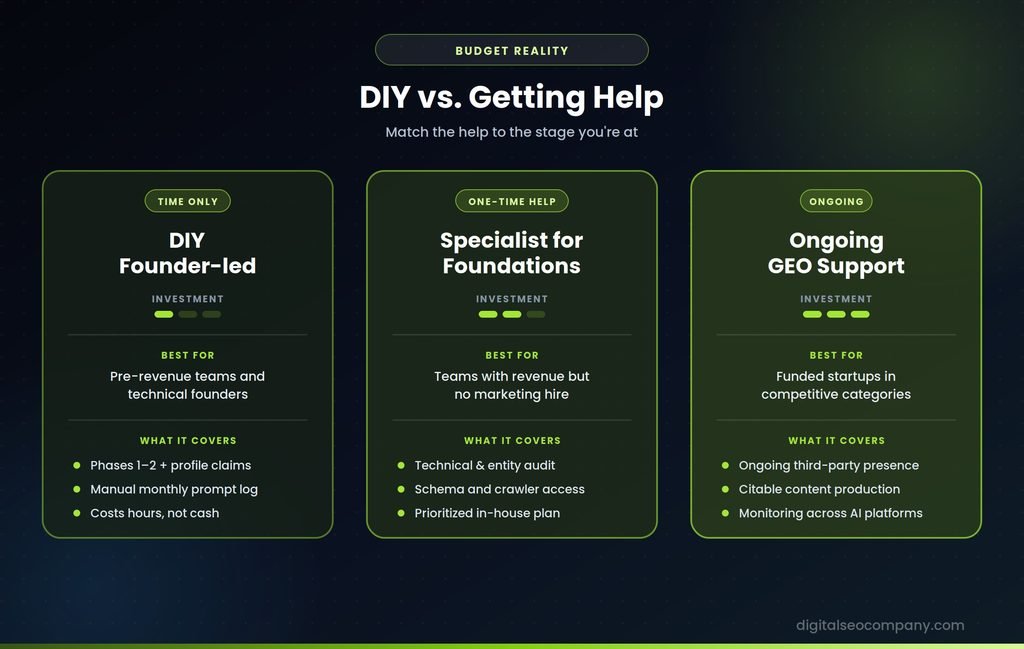
Budget Reality: DIY vs. Getting Help
| Approach | Best for | What it covers |
|---|---|---|
| DIY (time only) | Pre-revenue teams, technical founders | Phases 1–2 and a manual prompt log; slow but costs founder hours, not cash |
| Specialist for foundations | Teams with revenue but no marketing hire | A one-time technical and entity audit, schema, crawler access, a prioritized plan to execute in-house |
| Ongoing GEO support | Funded startups in competitive categories | Continuous third-party presence, citable content, and monitoring across AI platforms |
A sensible pattern for many startups: do Phase 1 and the profile claims yourself, then pay for a specialist only where expertise saves time — typically the technical audit, structured data, and a measurement setup. Our GEO services are structured that way: a focused foundation first, with ongoing support only if the data shows it’s worth it.
How to Evaluate GEO Services as a Startup
Be skeptical of anyone who:
- Guarantees citations or rankings in AI answers. Outcomes depend on model behavior no vendor controls.
- Leads with llms.txt as the main deliverable.
- Can’t explain their measurement: Ask how they track mentions across ChatGPT, Perplexity, Gemini, and AI Overviews separately, and how often.
- Relies on bulk low-quality placements: or fake reviews, which can harm both reputation and eligibility.
Good questions to ask: What do you fix first, and why? How will we know it’s working at 60 days? What should we do ourselves instead of paying you for?
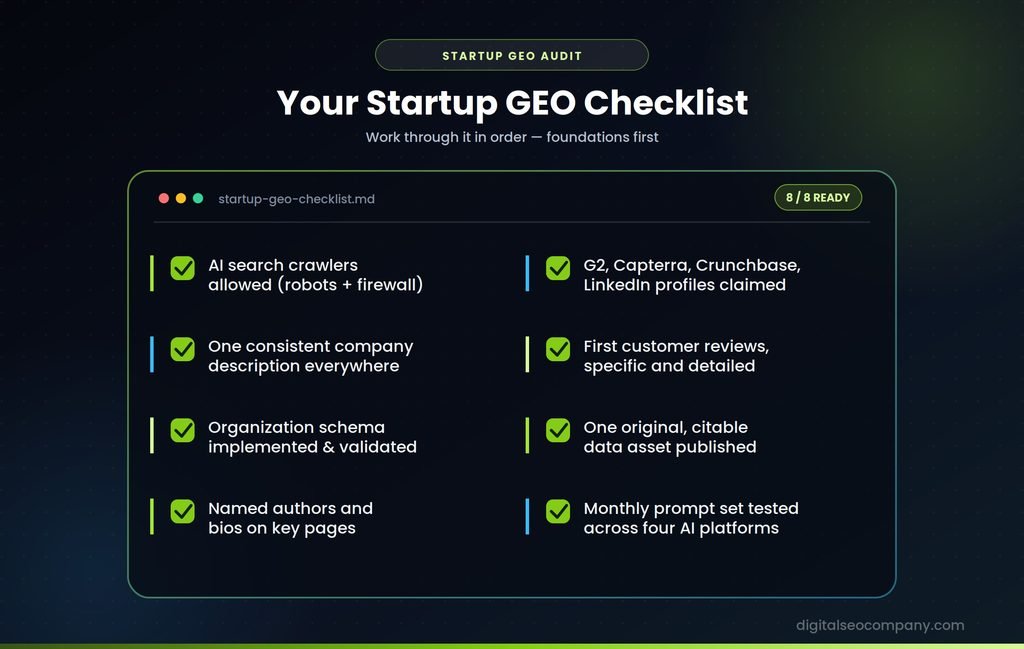
Startup GEO Checklist
- AI search crawlers confirmed allowed in robots.txt and at the firewall level
- One consistent company description used everywhere
- Organization schema implemented and validated
- Named authors and bios on key pages
- G2/Capterra/Crunchbase/LinkedIn profiles claimed and consistent
- First customer reviews collected with specific detail
- One original, citable data asset published
- Fixed monthly prompt set tested across four AI platforms
Frequently Asked Questions
How much should a startup spend on GEO?
- There’s no standard figure, and early GEO work is mostly time rather than cash: crawler access, consistent entity data, profile claims, and a manual prompt log cost founder hours. Paid help makes sense where expertise saves time, such as technical audits and structured data.
How long does GEO take to show results?
- Plan on months, not weeks. Third-party mentions and reviews accumulate slowly, and AI citation outcomes are probabilistic rather than guaranteed, so expect gradual movement you measure monthly.
Can a new startup compete with established brands in AI answers?
- Sometimes, particularly on narrower queries. Established brands have more mentions and reviews, but AI systems also surface specific, well-documented answers, so a clear niche with consistent third-party evidence can earn mentions in category-specific prompts.
Is GEO different from SEO for a startup?
- They overlap heavily — crawlability, clear content, and structured data matter to both — but GEO puts more weight on off-site mentions, reviews, and consistent entity information across platforms.
Do I need a GEO agency?
- Not at the start. Many startups can complete Phases 1 and 2 themselves, then bring in a specialist for audit, schema, and measurement once there’s revenue to justify it.
Final Thought
For a startup, GEO isn’t a content-volume contest — it’s an evidence problem. Make your own site unambiguous, build a small and consistent footprint where buyers’ questions pull from, publish one thing worth citing, and measure honestly. Do that in order, and a limited budget goes much further than it would on the usual approach of publishing first and hoping.You can also start with a free GEO audit with us.