
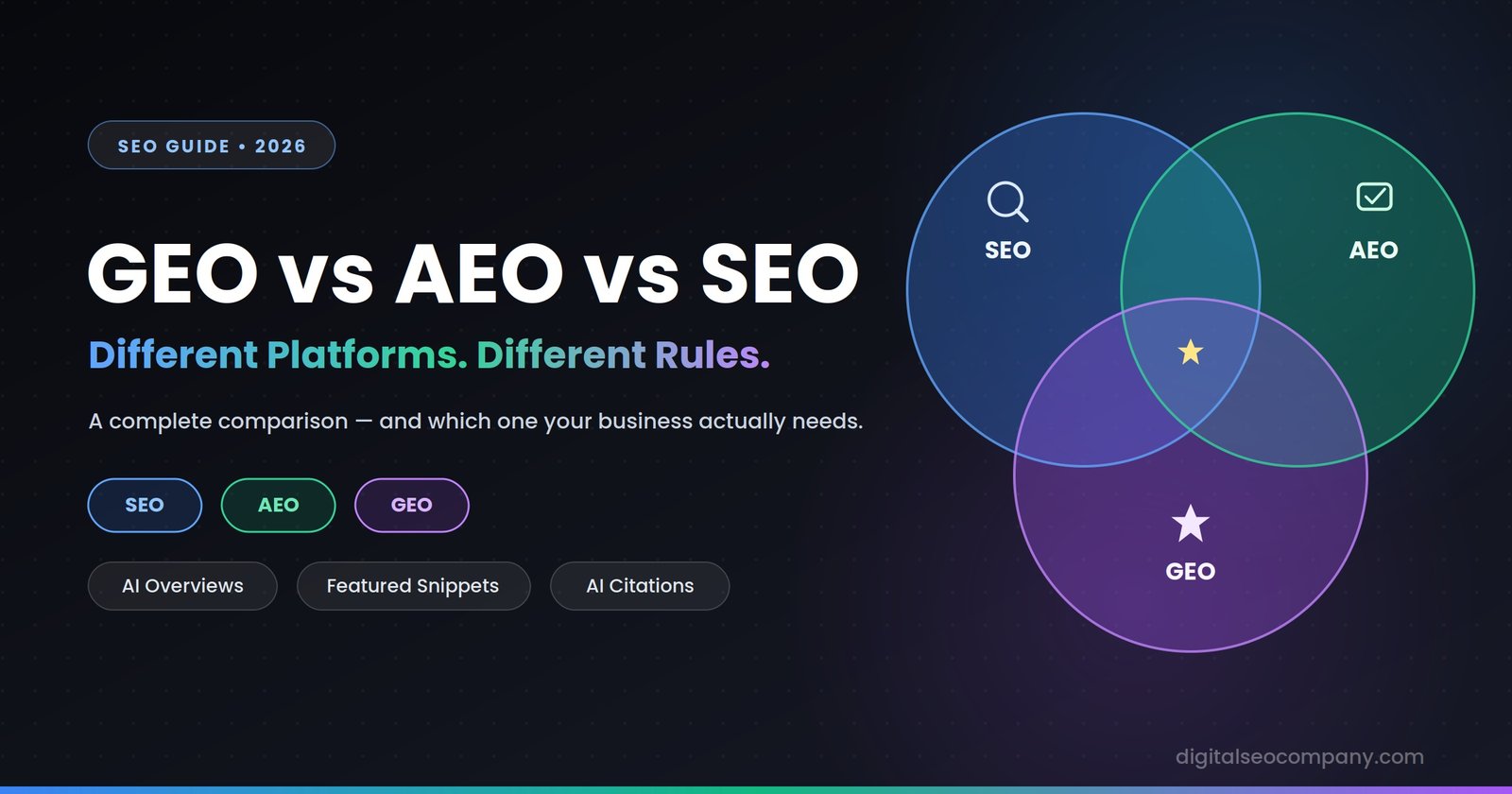
SEO, AEO, and GEO are three related but distinct disciplines: SEO optimizes for ranking in traditional search results, AEO optimizes for being selected as a direct answer (featured snippets, voice assistants, AI answer boxes), and GEO optimizes for being cited and recommended inside AI-generated responses from tools like ChatGPT, Perplexity, and Google AI Overviews. They share a foundation — quality content, authority, and structure — but they target different surfaces, measure success differently, and increasingly require different tactics to win.
If you’ve felt like “SEO” suddenly needs two new acronyms bolted onto it, you’re not imagining things. Search itself has split into three overlapping surfaces, and each one now has its own optimization discipline.
Why This Distinction Suddenly Matters
For twenty years, “ranking well” and “getting found” meant the same thing. That’s no longer true. Google’s AI Overviews now reach a large share of monthly searches, a growing majority of Google searches end without a click to any third-party site at all, and tools like ChatGPT process billions of prompts a day — a significant share of which function as search queries that never touch a traditional search engine.
The practical result: a page can rank #1 on Google and still generate zero traffic, because the answer was already given directly on the results page or inside an AI chat window. That’s the gap SEO, AEO, and GEO now split between them.
What Is SEO?
Search Engine Optimization is the practice of improving a page’s visibility in traditional search engine results — Google and Bing’s ranked list of blue links. It’s a first-party game: almost everything you do lives on your own website — title tags, headers, internal linking, page speed, and content depth. Success is measured in rankings, organic traffic, and click-through rate.
SEO itself has sub-disciplines worth knowing if you’re new to this: on-page SEO governs the content and structure of individual pages, technical SEO governs whether search engines can crawl and index your site at all, and backlinks and off-page SEO govern how much external trust and authority your domain has earned.
What Is AEO?
Answer Engine Optimization is the practice of structuring content so it gets selected as a direct answer — in Google’s featured snippets, voice assistant responses (Siri, Alexa, Google Assistant), and the AI answer boxes that now sit directly in search results. AEO operates on an answer-first model: the user often gets what they need without clicking anything at all.
AEO builds directly on SEO fundamentals but adds a specific formatting discipline — content has to be extractable as a self-contained answer, usually in the first sentence or two of a section, in a format (a definition, a list, a table) that a machine can lift cleanly out of context. Get our AEO services.
What Is GEO?
Generative Engine Optimization is the practice of getting your brand and content cited or recommended inside responses generated by large language models — ChatGPT, Claude, Gemini, Perplexity, and Google’s AI Mode. Unlike SEO, GEO is largely a third-party game: these systems assemble an answer by synthesizing your site alongside competitors, Reddit threads, YouTube videos, and industry publications. Winning at GEO means earning a seat in that synthesis, not just optimizing a page.
Some frameworks describe GEO as roughly 80% strategic (brand positioning, ecosystem presence, being talked about consistently across the web) and only 20% technical — a meaningfully different balance than traditional SEO, where technical execution carries much more of the weight. Digital SEO Company also offering top notch GEO services.
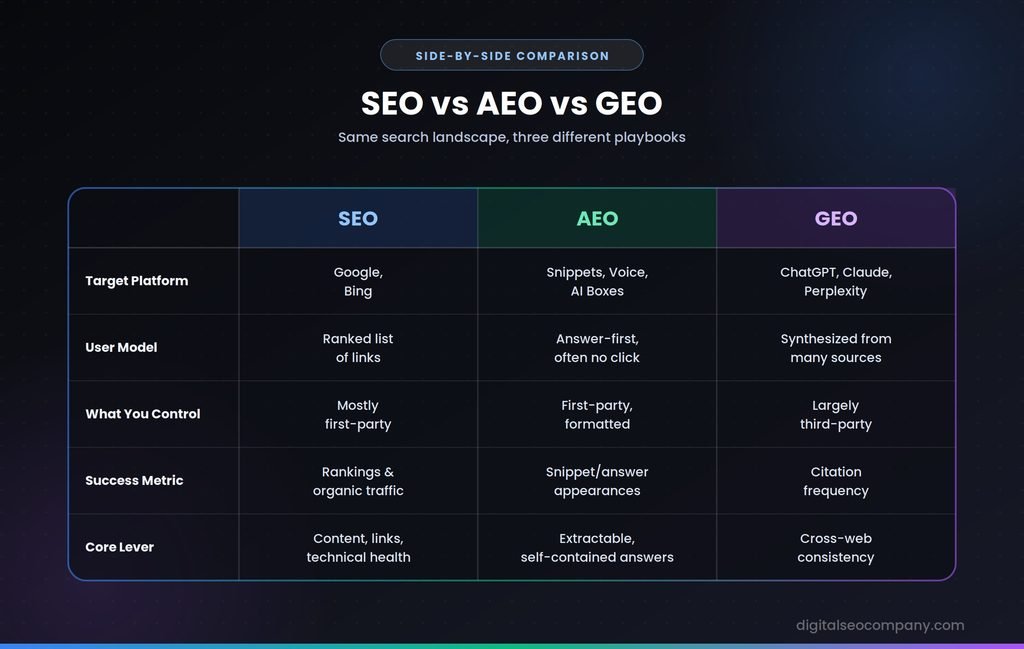
GEO vs. AEO vs. SEO: Side-by-Side Comparison
| SEO | AEO | GEO | |
| Target platform | Google, Bing search results | Featured snippets, voice assistants, AI answer boxes | ChatGPT, Claude, Gemini, Perplexity, AI Mode |
| User model | Ranked list of links | Answer-first, often no click | Synthesized answer from multiple sources |
| What you control | Mostly first-party (your site) | Mostly first-party, formatted for extraction | Largely third-party (reputation across the web) |
| Success metric | Rankings, organic traffic, CTR | Snippet/answer-box appearances | Citation frequency, brand mention accuracy |
| Core lever | Content, links, technical health | Extractable, self-contained answers | Cross-web consistency and authority |
Where They Overlap
The three disciplines aren’t competing — they’re layered. All three reward the same underlying qualities:
- E-E-A-T (Experience, Expertise, Authoritativeness, Trustworthiness) matters to Google’s core algorithm, its AI Overviews, and every major LLM’s citation logic
- Schema markup and structured data help all three — it’s the clearest, least ambiguous signal you can give any system, human-built or AI
- Topic cluster architecture (pillar pages with well-linked spoke content) builds the kind of depth that ranks, gets featured, and gets cited
- Clear, well-organized writing — short, self-contained sections with direct answers — helps a featured snippet, an AI Overview, and a human skimmer equally
In practice, a site with weak SEO fundamentals rarely does well at AEO or GEO either — the same technical and content foundation feeds all three.
An Honest Note on the Terminology
Worth being direct about this: there is no settled, universal definition separating AEO from GEO. Some practitioners treat them as genuinely distinct — AEO covering the structured, snippet-level answer surface, GEO covering the broader multi-source narrative an LLM assembles about your brand. Others argue they’re effectively the same discipline with two competing names, and that “AEO” will age better since “generative engines” is a more abstract, less durable term than “answer engines.” A third camp uses AIO (AI Search Optimization) as an umbrella term covering both.
As of 2026, the industry hasn’t converged on one standard. If a client or colleague uses these terms slightly differently than this article does, that’s not a sign either of you is wrong — it reflects genuine, ongoing disagreement in a very new field. What matters more than the label is understanding the three underlying surfaces (ranked results, direct answers, generated citations) and optimizing for all of them.
Which One Does Your Business Actually Need?
In almost every case: all three, layered on top of each other, not chosen instead of one another.
- SEO is the foundation. Without it, there’s no domain authority, no crawlable site, and no content depth for AEO or GEO to build on.
- AEO captures the “zero-click” searcher — increasingly the majority of searches — where visibility (even without a click) still builds brand recognition and can drive direct traffic when your brand is trusted enough to be searched by name.
- GEO captures the growing share of research and buying decisions now happening inside AI chat interfaces before a user ever opens a search engine.
Skipping SEO to chase GEO is the most common mistake right now — but GEO’s own signals are mostly earned through strong SEO and content practices, so there’s no real shortcut around the foundation.
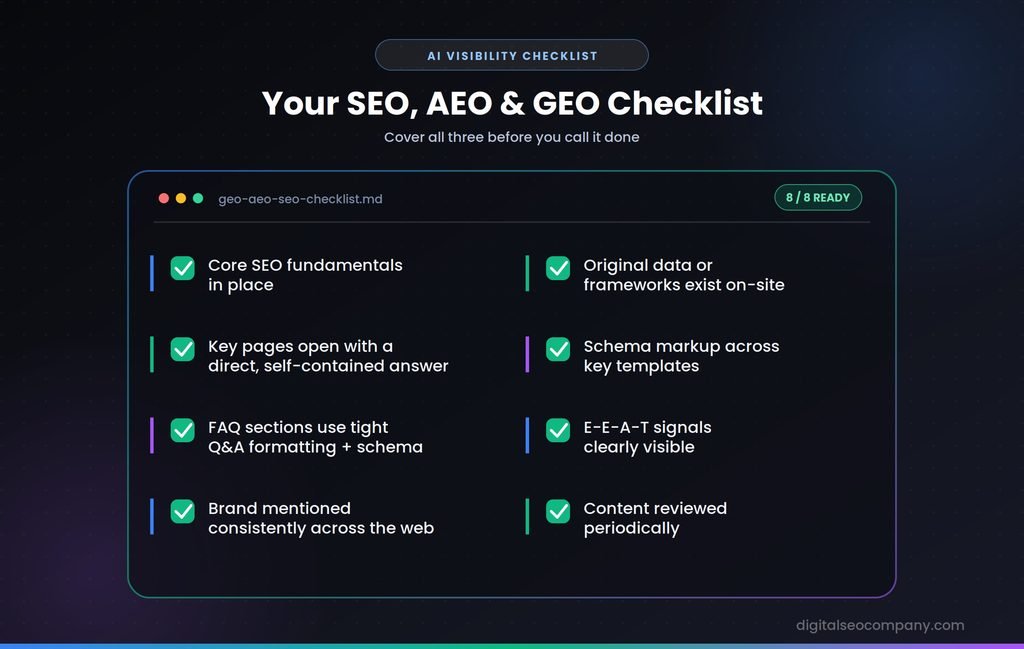
GEO vs. AEO vs. SEO Checklist
- Core SEO fundamentals in place — technical health, on-page structure, backlink profile.
- Key pages open with a direct, self-contained answer before expanding into detail (AEO).
- FAQ sections use tight, extractable Q&A formatting with schema markup.
- Brand is mentioned consistently and accurately across third-party sites, forums, and directories (GEO).
- Original data, frameworks, or insights exist somewhere on the site — the raw material AI systems actually cite.
- Schema markup implemented across key templates (Article, FAQPage, Organization).
- E-E-A-T signals visible — real authorship, credentials, sourcing.
- Content reviewed periodically, since AI citation sources can shift faster than traditional rankings.
Common Misconceptions
- “GEO replaces SEO.” It doesn’t — it depends on it. Weak SEO fundamentals undermine GEO citation potential just as much as they undermine rankings.
- “AEO and GEO are the same thing, so pick one term and move on.” Reasonable practitioners disagree here, and treating them as fully interchangeable is defensible — but conflating the practices (snippet optimization vs. cross-web brand presence) rather than just the labels can cause you to under-invest in one or the other.
- “If I’m not being cited by ChatGPT, my content has failed.” GEO citation is genuinely harder to control than a ranking, since it depends on how a model chooses to synthesize sources at generation time — it’s a probabilistic outcome, not a guaranteed placement the way a #1 ranking can be.
FAQ
What’s the main difference between AEO and GEO?
- AEO focuses on getting content selected as a direct answer — in featured snippets, voice assistants, and AI answer boxes. GEO focuses on getting cited or recommended inside AI-generated responses from tools like ChatGPT and Perplexity. Many practitioners consider them closely related or even interchangeable; the field hasn’t settled on a single standard definition yet.
Is SEO still worth doing if AEO and GEO exist?
- Yes — SEO remains the foundation both AEO and GEO build on. The technical health, content depth, and authority signals that drive traditional rankings are largely the same signals that earn featured snippets and AI citations.
Do I need to choose between SEO, AEO, and GEO?
- No. They target different surfaces of the same overall search landscape, and the strongest approach layers all three rather than picking one.
What does GEO stand for?
- Generative Engine Optimization — the practice of structuring content and brand presence so generative AI tools cite or recommend you in their responses.
What does AEO stand for?
- Answer Engine Optimization — the practice of structuring content so it’s selected as a direct answer across featured snippets, voice assistants, and AI answer boxes.
Final Thought
The acronyms will probably keep shifting for a while — that’s normal in a field this new. What won’t shift is the underlying shape of the problem: search has split into ranked results, direct answers, and generated citations, and a business that only optimizes for the first one is leaving two-thirds of modern search visibility on the table. Wants to get a free SEO and GEO audit?